

About this publication
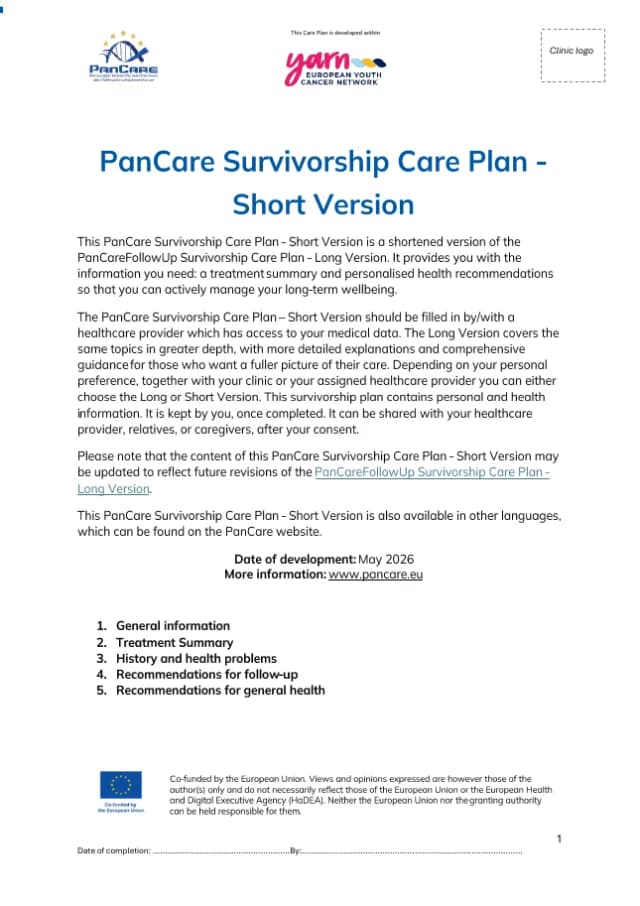
The PanCare Survivorship Care Plan (SCP) – Short Version was developed by PanCare, the pan-European network for survivors of childhood, adolescent and young adult cancer, within the YARN – European Youth Cancer Network work package on transition and long-term follow-up care. It is a shortened version of the PanCareFollowUp Survivorship Care Plan – Long Version and gives a survivor the two things they most need after treatment: a summary of the treatment they received and personalised health recommendations, so that they can actively manage their long-term wellbeing.
- Date of development: May 2026
- Available in 11 languages (English, Dutch, German, Greek, French, Italian, Lithuanian, Polish, Portuguese, Romanian and Spanish) as a PDF and as an editable Word document; every version is on the YARN project page
- Filled in by, or together with, a healthcare provider who has access to the survivor's medical data
- Kept by the survivor once completed, and shared with healthcare providers, relatives or caregivers only with the survivor's consent
PanCare notes that the content of the short version may be updated to reflect future revisions of the long version. Co-funded by the European Union; views and opinions expressed are those of the authors only and do not necessarily reflect those of the European Union or the European Health and Digital Executive Agency (HaDEA).
What a survivorship care plan is
About two in three survivors of childhood, adolescent and young adult cancer experience a health problem later in life that is caused by the cancer or its treatment. Which late effects a person is at risk of depends on exactly what was given: which drugs and in what cumulative doses, which parts of the body were irradiated, which operations were done. A survivorship care plan is the document that keeps that history together with the follow-up it calls for.
It has two halves. The treatment summary records the diagnosis and every treatment received, in the codes and units that follow-up guidelines are written for. The care recommendations translate that history into a personal follow-up schedule: which late effects to watch for, which checks are advised by evidence-based guidelines, and what the survivor and their healthcare provider have decided together. PanCare's follow-up recommendations for the surveillance of late effects and its PLAIN language summaries are the sources the plan points to.
An individualised survivorship care plan for every survivor is one of the six key components of long-term follow-up (LTFU) care recommended by PanCare. The EU-CAYAS-NET recommendations for LTFU care and the LTFU care summary on the YARN project page set out the other five.
Short version or long version?
The short version, published here, is six pages and is designed to be completed during a follow-up visit and carried by the survivor. The long version covers the same topics in greater depth, with more detailed explanations and comprehensive guidance for those who want a fuller picture of their care. Which one to use is a personal choice, made together with the clinic or the assigned healthcare provider. Both versions contain personal and health information, are kept by the survivor once completed, and can be shared with a healthcare provider, relatives or caregivers after the survivor's consent.
The five sections explained
Every page of the plan carries a line for the date of completion and the name of the person who completed it, so that anyone reading it later knows how current it is.
1. General information
Part 1a records the basic information any healthcare professional needs to find the right person and the right records.
| Field | What to enter |
|---|---|
| (Preferred) name | The name the survivor wants to be called |
| Date of birth | DD/MM/YYYY |
| Sex at birth | As recorded at birth |
| Gender identity | As the survivor describes it |
| Telephone number, e-mail address | Current contact details |
| Names of parents / caregivers | If applicable |
| Emergency contact person, and their telephone number | Who to call |
| Treatment centre | The hospital where the cancer was treated |
| Treating oncologist | Name |
| General practitioner | Name and practice |
| Allergies | If applicable |
Part 1b, current medications, lists every medication that is currently needed.
2. Treatment summary
This part describes the diagnoses and all treatments received. It is the part only the treating hospital can complete reliably, because the entries use the coding and cumulative doses that follow-up guidelines are written for.
| Field | What to enter |
|---|---|
| Primary cancer diagnosis | ICCC-3 code or ICD-O-3 (v1) code, including laterality if applicable |
| Date of primary diagnosis | DD/MM/YYYY |
| Progression, relapse | Yes or no, each with its date |
| Metastases | Yes, no or not applicable |
| Secondary malignancy | Yes or no; if yes, its ICCC-3 or ICD-O-3 code and the date of diagnosis |
| Chemotherapy | Yes or no; the type(s) of chemotherapy, for all diagnoses combined |
| Total amount of anthracyclines | Cumulative dose, for all diagnoses combined |
| Total amount of alkylating agents | Cumulative dose, for all diagnoses combined |
| Radiotherapy | Yes or no; type (for example protons or photons), total amount and field |
| Stem cell transplantation | Yes or no; type and date of the procedure |
| Major surgery | Yes or no; type and date of the procedure |
| Immunotherapy | Yes or no; type |
| Other therapy | Yes or no; type(s) |
Follow-up guidelines use these entries, above all the cumulative anthracycline and alkylating-agent doses and the radiotherapy fields, to decide which surveillance a survivor needs, so this is the section worth getting exactly right.
3. History and health problems
A dated list of any serious health problems, physical and mental, during and after treatment, including late effects that have already been diagnosed, each marked as current or past.
Part 3a, other medical history, adds what else is relevant to know: congenital or hereditary diseases, medical history in the family, and anything else.
4. Recommendations for follow-up
This part explains why it is important to monitor health closely after being treated for cancer at a young age. Because treatments can increase the risk of developing physical and mental health problems later in life, any symptom should be reported to a doctor right away; early reporting helps identify potential causes sooner and can prevent more serious health issues.
The recommendations themselves form a table with five columns, read left to right as one sentence.
| Column | Reads as |
|---|---|
| Treatment | "Because you were treated with…" – the treatment that may cause a risk of a certain late effect |
| Risk | "…you may have a risk of…" – the specific risk caused by that treatment |
| Advice | "…therefore, we advise that you get the following care:" – based on evidence-based guidelines |
| Shared decision | "The decision that you together with your healthcare provider have made about your care" |
| Remarks | Any remarks or deviations, and possible contact persons for that care |
Part 4a records the decisions about care that are personally important for the survivor. Part 4b holds direct links to the relevant PanCare PLAIN summaries, which explain each recommendation in plain language.
5. Recommendations for general health
This part describes why it is important to take care of general health. A healthy lifestyle improves the processes in the body that help a person feel good both physically and mentally, and can reduce the risk of fatigue, depression, cardiovascular disease, new (secondary) malignancies and other (mental) health problems. The plan gives the same recommendations to every survivor.
Regarding a healthy lifestyle
- Have enough sleep
- Exercise regularly (at least 3 times a week)
- Maintain a healthy weight (adult BMI between 18.5 and 24.9 kg/m²)
- Eat plenty of fruits and vegetables; reduce your intake of fats, sugar and salt
- Don't smoke, or quit if you currently smoke
- Limit alcohol consumption
- Protect your skin: use sunscreen and avoid excessive sunbathing
Regarding physical health
- Have your teeth checked regularly
- Monitor your health measurements, including weight and blood pressure
- Participate in any cancer screenings you may be invited to
- Receive all vaccinations as recommended in national guidelines
Regarding mental health
- Connect with others
- Make time for yourself
- Reach out to family members or close friends when you experience negative emotions
- Engage in hobbies you enjoy or explore new interests and activities
- Practise mindfulness
- Use relaxation techniques
- Seek professional help if needed
Regarding social health
- Discuss problems or questions about managing your daily life, such as work, school, relationships or finances, with your physician if they occur
- Feel free to share your needs with your loved ones
Part 5a leaves space for comments.
How to complete it with your clinician
- Get the plan in your language. Download the PDF or the editable Word file from the YARN project page, or open our Survivorship Care Plan Builder to type the entries in your browser and print or save the completed plan as a PDF. Nothing you type in the builder leaves your device.
- Fill in section 1 yourself. Name, contacts, treatment centre, oncologist, general practitioner, allergies and current medications are things you know; having them ready shortens the visit.
- Ask the treating hospital for the treatment summary. Section 2 needs the diagnosis codes, the cumulative doses of anthracyclines and alkylating agents and the radiotherapy fields from your medical records. Ask your treating oncologist, the long-term follow-up clinic or the hospital's medical records department; if you have moved or changed hospitals, the original treatment centre still holds these data. PanCare publishes a treatment summary template that clinics can use.
- Go through sections 3 and 4 together. Your healthcare provider matches your treatments to the risks and surveillance in the PanCare follow-up recommendations, and you record together what you have decided, including anything you have chosen not to do and who to contact for each item.
- Keep it, and bring it. The completed plan is yours. Show it to any new doctor, general practitioner or specialist, share it with family or caregivers if you want to, and ask for it to be updated after every follow-up visit or new diagnosis.
If there is no long-term follow-up clinic near you, the European map of long-term follow-up care shows where structured LTFU care exists, and the EU-CAYAS-NET transition guideline explains what a well-organised handover from paediatric to adult care looks like.
Frequently asked questions
What is a survivorship care plan?
A survivorship care plan is a personal document for someone who has finished treatment for cancer. It has two parts: a treatment summary that records the diagnosis and every treatment received, and personalised recommendations for follow-up care and healthy living based on that history. It is kept by the survivor and shared with healthcare providers, relatives or caregivers only with their consent. The PanCare Survivorship Care Plan – Short Version is a six-page plan for survivors of childhood and adolescent cancer.
Who fills it in?
A healthcare provider who has access to the survivor's medical data, either on their own or together with the survivor. The survivor can complete the general information and current medications, but the treatment summary and the follow-up recommendations need the treating hospital's records and a clinician's reading of the follow-up guidelines. Every page carries the date of completion and the name of the person who completed it.
What is a treatment summary?
The treatment summary is section 2 of the plan: the primary cancer diagnosis with its ICCC-3 or ICD-O-3 code and date, any progression, relapse, metastases or secondary malignancy, and each treatment received – chemotherapy with the cumulative doses of anthracyclines and alkylating agents, radiotherapy with its type, dose and field, stem cell transplantation, surgery, immunotherapy and other therapies, each with dates. Follow-up guidelines use exactly these details to decide which late effects to screen for, which is why the summary is written in codes and cumulative doses rather than in everyday words.
What is the difference between the short and the long version?
Both come from PanCare and cover the same topics. The short version, published here, is six pages and gives the information a survivor needs: the treatment summary and personalised health recommendations. The PanCareFollowUp Survivorship Care Plan – Long Version explains each topic in greater depth, with more detailed explanations and comprehensive guidance. Survivors choose between them together with their clinic or assigned healthcare provider.
This publication is part of YARN – European Youth Cancer Network.