
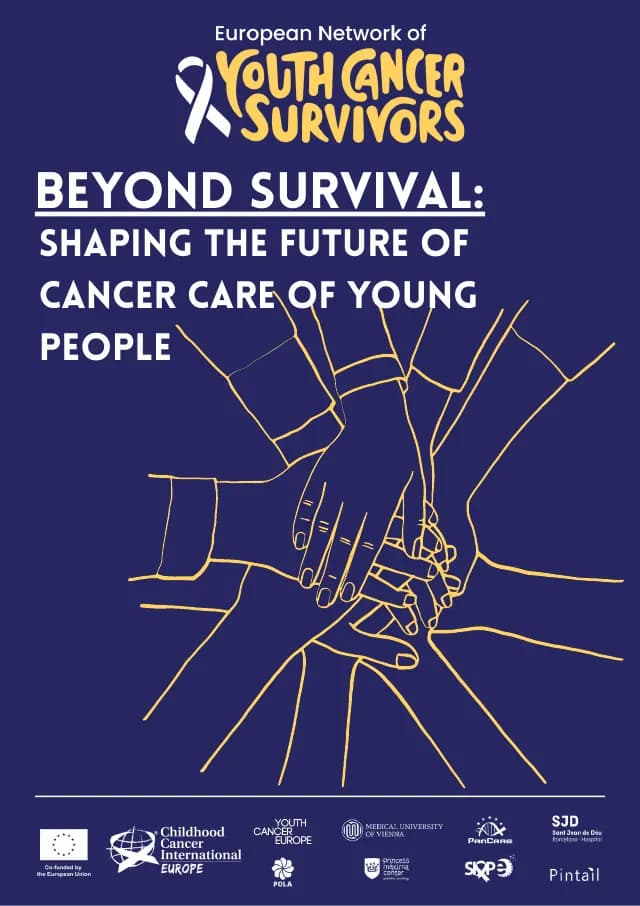
Over deze publicatie
Versie 1.0, juli 2025
Project gefinancierd door de Europese Commissie. Subsidieovereenkomst nr. 101056918. EU4Health-programma.
Uitgever: Childhood Cancer International – Europe (CCI-E) & Youth Cancer Europe (YCE), namens het EU-CAYAS-NET-project
Samenstelling van resultaten & redactie (in alfabetische volgorde) namens het EU-CAYAS-NET-consortium
- Childhood Cancer International - Europe: Anna Zettl, Barbara Brunmair
- Youth Cancer Europe: Ana Totovina, Carmen Mongue-Montero, Urska Kosir
Beoordeling & proeflezing: Hannah Gsell, Ian Murphy, Puck Slaats, Teresa Bastos Pais, Anita Kienesberger
Concept & ontwerp: Anna Zettl, Hannah Gsell, Anita Kienesberger
Illustraties (met uitzondering van de omslagillustratie): Andrea Ruano Flores
Dankbetuigingen
Dit project – samen met de resultaten, materialen en het netwerk dat het heeft bevorderd – kon alleen tot stand komen dankzij de geweldige begunstigden, geassocieerde partners en natuurlijk onze fantastische community. Wij spreken onze oprechte dank uit aan iedereen die betrokken was voor uw samenwerking, toewijding en de inspanningen die u hebt geleverd om dit mogelijk te maken.
Een zeer bijzonder woord van dank gaat uit naar alle jongeren met ervaringsdeskundigheid die hun energie en vrije tijd aan het project, de resultaten ervan en de bijbehorende evenementen hebben besteed – terwijl zij tegelijkertijd hun voornaamste professionele verplichtingen in balans hielden. Uw vrijgevigheid en betrokkenheid maakten deze reis werkelijk bijzonder.
Auteurs & affiliaties van de EU-CAYAS-NET-middelen (in alfabetische volgorde)
- Childhood Cancer International - Europe: Barbara Brunmair, Hannah Gsell, Carina Schneider, Oriana Sousa, Tiago Pinto da Costa
- Medical University of Vienna: Inga Bosch, Marie-Therese Gubi, Doris Hoffmann-Lamplmair, Kerstin Krottendorfer, Ulrike Leiss, Anika Rupprecht, Liesa J. Weiler-Wichtl, Anna Zettl
- PanCare: Jeroen te Dorsthorst, Tessa Fuchs, Cherine Mathot, Heleen van der Pal
- Princess Maxima Center: Alied van der Aa, Jaap den Hartogh, Leontine Kremer, Jikke Wams
- Youth Cancer Europe: Victor Girbu, Urška Košir, Carmen Monge-Montero, Steward O'Callaghan, Emily Pattinson (Inclusive Employers), Katie Rizvi, Ana Maria Totovina
Inleiding
Alleen al in Europa wordt het aantal overlevers van kanker op kinderleeftijd, in de adolescentie en jongvolwassenheid (CAYA) geschat op 500.000 personen en naar verwachting zal dit aantal elk jaar met 12.000 toenemen (van Kalsbeek et al., 2022). Hoewel de overlevingskansen gestaag zijn verbeterd dankzij vooruitgang in behandelingen, eindigt de reis niet bij remissie. Overlevers, met name kinderen, adolescenten en jongvolwassenen (CAYA's), worden vaak geconfronteerd met levenslange uitdagingen. Deze uitdagingen beperken zich niet tot de lichamelijke gezondheid, maar omvatten ook mentaal welzijn, sociale integratie, onderwijs en loopbaanontwikkeling.
Ondanks hun unieke behoeften ondervinden veel jonge kankerpatiënten nog steeds aanzienlijke ongelijkheden in de toegang tot gespecialiseerde zorg, met name in regio's buiten de grote stedelijke centra in West- en Noord-Europa. Deze hiaten onderstrepen de dringende behoefte aan uniforme zorgstandaarden op het hele continent, zodat alle jongeren die met kanker te maken krijgen de holistische, persoonsgerichte ondersteuning ontvangen die zij verdienen.
Om deze uitdagingen aan te pakken, ging het EU-CAYAS-NET-project in september 2022 van start met steun van het EU4Health-programma (subsidienr. 101056918), als onderdeel van Europe's Beating Cancer Plan. Het project verenigt 9 kernpartners en 28 geassocieerde organisaties in 18 landen en creëert daarmee een grensoverschrijdend samenwerkingsverband van patiënten, overlevers, onderzoekers, zorgprofessionals en beleidsmakers.
De missie van EU-CAYAS-NET is het verbeteren van de kwaliteit van leven van CAYA-kankerpatiënten en -overlevers door samenwerking, co-creatie en kennisuitwisseling te bevorderen. Centraal in deze missie staan door patiënten geleide initiatieven die een hogere standaard voor kankerzorg in heel Europa definiëren en bevorderen. Belangrijke thema's van dergelijke initiatieven zijn mentale gezondheid en psychosociale zorg, onderwijs en loopbaan, langdurige follow-up en transitie in de zorg.
De impact van kanker eindigt niet wanneer de behandelingen stoppen. Jongeren die na hun ziekte verder leven, worden vaak geconfronteerd met aanhoudende lichamelijke late effecten, emotionele belasting, verstoord onderwijs en werk, en uitdagingen bij de integratie in de gezondheidszorg voor volwassenen. Deze lasten kunnen vooral zwaar wegen tijdens de adolescentie en vroege volwassenheid, cruciale perioden voor identiteitsvorming, groeiende zelfstandigheid en persoonlijke ontwikkeling.
Via EU-CAYAS-NET wordt een Europees netwerk van jonge overlevers van kanker en een Interactief Kenniscentrum en Platform opgebouwd, gewijd aan gelijkheid, inclusie, kwaliteit van zorg en ondersteuning bij overleving. Het projectverband heeft als doel te waarborgen dat jongeren niet alleen overleven, maar ook tot bloei komen; ondersteund door evidence-based praktijken, sterke gemeenschappen en persoonsgerichte zorgsystemen.
Ga naar: www.beatcancer.eu om het project te volgen en meer te ontdekken
Projectpartners
Hoe u deze collectie kunt gebruiken
Deze digitale brochure brengt alle academische publicaties, conferentiepresentaties, onderzoeksresultaten en praktische materialen samen die in het kader van het EU-CAYAS-NET-project zijn ontwikkeld. Zij fungeert als een centrale, zich ontwikkelende bron voor onderzoekers, CAYA's met persoonlijke ervaring met kanker, naasten en zorgprofessionals. De brochure belicht het wetenschappelijke bewijs, innovaties en de geleefde ervaringen die de toekomst van kankerzorg en nazorg voor jongeren vormgeven.
Alle projectresultaten zijn georganiseerd in acht belangrijke thematische gebieden die de kernfocus van het project weerspiegelen:
- Projectambassadeurs
- Discord-community & website
- Mentale gezondheid en psychosociale zorg
- Onderwijs- en loopbaanmogelijkheden
- Zorgtransities
- Late effecten en langdurige follow-upzorg
- Normen voor AYA-kankerzorg in heel Europa vaststellen
- Gelijke kansen, diversiteit en inclusie
Elk thematisch gebied bevat een korte inleiding op het onderwerp, gevolgd door een samengestelde lijst van gerelateerde projectresultaten. Elke vermelding bevat een formele titel en, waar nuttig, een toegankelijke titel om de toegankelijkheid voor zowel professionele als niet-gespecialiseerde lezers te waarborgen. De betrokken auteurs en instellingen worden vermeld om bijdragers te erkennen en samenwerking te bevorderen. Waar relevant, licht een onderdeel over Patient and Public Involvement and Engagement (PPIE) toe hoe jongeren met ervaringsdeskundigheid en hun families hebben geholpen het werk vorm te geven—een essentieel element van persoonsgericht onderzoek en persoonsgerichte zorg.
De vermeldingen zijn duidelijk gemarkeerd met het type resultaat (bijv. academisch artikel, webinar, richtlijnen), met directe links voor snelle toegang. Elke samenvatting biedt ook de motivatie en doelstellingen van het werk, de gebruikte methodologie, de belangrijkste bevindingen en kernpunten, toekomstige richtingen, evenals de belangrijkste implicaties voor HCPs, CAYA's en andere belanghebbenden zoals beleidsmakers.
Deze gestructureerde, gebruiksvriendelijke opzet stelt lezers in staat snel te begrijpen wat er is gedaan, waarom het belangrijk is en hoe het kan worden toegepast om zorg en ondersteuning in heel Europa te verbeteren.
OPMERKING: Dit is een levend document en zal blijven groeien naarmate aanvullende projectresultaten beschikbaar komen en nieuwe publicaties verschijnen. Raadpleeg deze brochure regelmatig voor updates en gebruik haar als instrument voor leren, belangenbehartiging, samenwerking en verandering.
- Educatieve video - Een mijlpaal in belangenbehartiging en onderzoek op het gebied van kanker: 34 maanden EU-CAYAS-NET
- Slotwebinar - Kijk terug op 34 maanden EU-CAYAS-NET, resultaten en volgende stappen!
Symbolen gebruikt in deze brochure
Om de duidelijkheid en het gebruiksgemak te vergroten, hebben wij symbolen in deze brochure opgenomen. Let er in de hele brochure op!
- Deze bron is beschikbaar in meerdere talen. Klik op het pictogram om dit te bekijken!
- Deze bron is een video die te vinden is op het YouTube-kanaal van European Cancer Survivors Network.
- Deze bron is lees- of praktisch materiaal dat u direct in uw dagelijkse werk kunt toepassen!
- Deze bron is een set pocketkaarten met praktische tips die u in uw dagelijkse werk kunt gebruiken!
- Deze bron is een wetenschappelijk artikel! Alle wetenschappelijke publicaties die binnen EU-CAYAS-NET zijn gerealiseerd, zijn vrij toegankelijk.
- Deze bron is een interactieve kaart!
- De resultaten over kwaliteit van leven zijn uitgebreider gepubliceerd in een afzonderlijk position paper. Klik op het pictogram en ontdek meer! (White paper over kwaliteit van leven)
- Uw oproep tot actie: bezoek het platform en sluit u aan bij de community!
- Deze bron is nog in ontwikkeling. Kom later terug voor updates!
Thematisch gebied 1: Projectambassadeurs
"Zij spelen een sleutelrol bij het vergroten van de bewustwording, het deelnemen aan nationale en internationale evenementen en het bijdragen aan beleidsdiscussies."
Begin 2023 lanceerde EU-CAYAS-NET het Youth Cancer Survivor Ambassador Programme. Ambassadeurs zijn jongeren met geleefde ervaring met kanker die deelnemen aan het netwerk om de projectdoelstellingen te communiceren en de projectresultaten te verspreiden onder belanghebbenden in hun lidstaat. Zij vormen een integraal onderdeel van EU-CAYAS-NET en nemen deel aan projectactiviteiten, zoals peer-bezoeken, richtlijnen, workshops en focusgroepdiscussies. Ambassadeurs verbinden het netwerk ook met nieuwe overlevers en andere belanghebbenden om de gemeenschap op te bouwen en het project in het algemeen te promoten.
Ambassadeurs werden geworven vanuit de netwerken van CCI-E en YCE, evenals vanuit andere begunstigden en geassocieerde partners. In mei 2025 hebben in totaal 55 jonge kankeroverlevers uit 29 Europese landen zich bij EU-CAYAS-NET aangesloten als officiële Ambassadeurs.
De Ambassadeurs van EU-CAYAS-NET fungeren nu als nationale contactpunten voor leven met en na kanker en slaan een brug tussen Europese en nationale inspanningen. Zij spelen een sleutelrol bij het vergroten van de bewustwording, het deelnemen aan nationale en internationale evenementen en het bijdragen aan beleidsdiscussies. Ambassadeurs ondersteunen ook gemeenschappen van overlevers, onder meer door leeftijdsgenoten uit te nodigen om zich aan te sluiten bij het Discord-platform (zie thematisch gebied 2) en toekomstige Ambassadeurs aan te moedigen om betrokken te raken. Zorgprofessionals en beleidsmakers kunnen contact opnemen met dit diverse netwerk voor toekomstige consultaties en samenwerking.
Vind hier meer informatie over elk van onze EU-CAYAS-NET Ambassadeurs.
Thematisch gebied 2: Website & Discord-community
"De Discord-community dient als een veilige ruimte waar jonge kankeroverlevers en supporters contact kunnen leggen, ervaringen kunnen delen en steun kunnen vinden."
De website van EU-CAYAS-NET dient als een uitgebreid knooppunt voor informatie, hulpmiddelen en begeleiding voor jonge kankerpatiënten en overlevers in heel Europa. Zij biedt een kenniscentrum met zorgvuldig geselecteerde en gestructureerde hulpmiddelen, waaronder artikelen, richtlijnen, position papers, educatieve materialen, evenals projectupdates en evenementen die relevant zijn voor jonge patiënten en overlevers. Daarnaast biedt zij tools om jongeren te versterken in hun traject van belangenbehartiging en zelfzorg. De website belicht ook best practices en beleidsontwikkelingen, waardoor zij een waardevolle bron is, niet alleen voor jongeren die met en na kanker leven, maar ook voor professionals en andere belanghebbenden die betrokken zijn bij zorg rond leven met en na kanker.
Website: www.beatcancer.eu
Daartegenover biedt de EU-CAYAS-NET-community op Discord een interactieve ruimte voor realtime contact en gesprekken, uitwisseling en steun. Zij biedt de mogelijkheid om uit te wisselen in themaspecifieke kanalen (bijv. mentale gezondheid, vruchtbaarheid, onderwijs, levensstijl), maar ook om lokale contacten of steun te vinden in landspecifieke kanalen. Er worden regelmatig community-evenementen georganiseerd die de mogelijkheid bieden om via het videokanaal contact te leggen met anderen. De Discord-community dient als een veilige ruimte waar jonge kankeroverlevers en supporters contact kunnen leggen, ervaringen kunnen delen en steun kunnen vinden.
Thematisch gebied 3: Hiaten in geestelijke gezondheidszorg en psychosociale zorg aanpakken
"Volgens het biopsychosociale model is het van vitaal belang dat geestelijke gezondheidszorg wordt geïntegreerd in de routinematige nazorg om de kwaliteit van leven van CAYA-kankeroverlevenden te verbeteren."
Een kankerdiagnose op jonge leeftijd – of dat nu in de kindertijd, adolescentie of vroege volwassenheid is – kan een levenslange impact hebben op de jongere zelf en op diens familie. Lange ziekenhuisopnames, intensieve behandelingen en verstoringen van school, werk en sociaal leven leiden vaak tot blijvende emotionele en psychologische uitdagingen. Veel overlevenden ervaren angst, depressie, vermoeidheid of cognitieve problemen. Helaas worden deze behoeften vaak over het hoofd gezien of verkeerd begrepen, en ondersteuning op het gebied van geestelijke gezondheid wordt zelden opgenomen in de routinematige nazorg. Een belangrijke belemmering voor passende zorg is het gebrek aan gespecialiseerde overlevingsklinieken die gepersonaliseerde psychosociale ondersteuning bieden. Volgens het biopsychosociale model is het van vitaal belang dat geestelijke gezondheidszorg wordt geïntegreerd in de routinematige nazorg om de kwaliteit van leven van CAYA-kankeroverlevenden te verbeteren.
Door nauwe samenwerking met mensen die leven met en na kanker, zorgprofessionals en andere belanghebbenden in heel Europa werd een holistische benadering gehanteerd om de behoeften op het gebied van geestelijke gezondheid en psychosociale zorg van jonge kankeroverlevenden te verkennen.
De uitkomsten over kwaliteit van leven zijn uitgebreider gepubliceerd in een afzonderlijk position paper.
Beoordeling van de huidige stand van zaken en hiaten in psychosociale zorg voor CAYA-kankeroverlevenden in Europa
De enquête onder 194 overlevenden uit 24 Europese landen bracht aanzienlijke hiaten aan het licht in de monitoring van geestelijke gezondheid en psychosociale ondersteuning na CAYA-kanker.
Werd u geïnformeerd dat psychosociale late effecten als gevolg van de ziekte of behandeling kunnen optreden?
Aandeel respondenten (waarden afgelezen van het staafdiagram, bij benadering):
- Nee: ongeveer 62%
- Ja: ongeveer 28%
- Ik weet het niet: ongeveer 9%
Methodologie
Er werd een verkennend literatuuronderzoek uitgevoerd. Daarnaast werd een Europa-brede online enquête onder jonge kankeroverlevenden gehouden en werden consensusbijeenkomsten georganiseerd om zowel kwantitatieve als kwalitatieve gegevens te verzamelen.
PPIE-highlight
In lijn met de principes van participatief onderzoek werd de studie uitgevoerd in nauwe samenwerking met patiëntexperts, patiëntenvertegenwoordigers en HCPs gedurende het volledige onderzoeksproces. Alle belanghebbenden waren actief betrokken in elke fase, van het ontwerpen van de onderzoeksinstrumenten en het verzamelen van gegevens tot het analyseren van resultaten, het interpreteren van bevindingen en het plannen van de verspreiding. Deze samenwerkingsgerichte aanpak had tot doel ervoor te zorgen dat het ontwerp, de inhoud en de methodologie van de behoeftenbeoordeling de diverse perspectieven en ervaringen van de betrokkenen nauwkeurig weerspiegelden.
Belangrijkste resultaten
Overlevenden meldden onvervulde behoeften op gebieden zoals angst, vermoeidheid, financiële stress, relaties en neuropsychologische uitdagingen. Velen vonden dat psychosociale late effecten niet adequaat werden aangepakt in de LTFU-zorg. In het bijzonder ontbrak het hun aan informatie over het risico op het ontwikkelen van deze problemen en over de ondersteuningsdiensten die voor hen beschikbaar zijn. Veelvoorkomende belemmeringen waren financiële beperkingen en een tekort aan nazorgverleners die psychosociale ondersteuning aanbieden.
Belangrijke resultaten uit deze enquête benadrukken de behoefte aan ondersteuning versus de daadwerkelijk ontvangen ondersteuning op het gebied van:
- Gevolgen van de ziekte of behandeling voor de sociale dimensie:
- Isolement: 51% had ondersteuning nodig – daarvan kreeg slechts 5,7% ondersteuning
- Toegenomen angst, angststoornis: 57% had ondersteuning nodig – daarvan kreeg slechts 8,2% ondersteuning
- Angst voor terugkeer van kanker: 54% had ondersteuning nodig – daarvan kreeg slechts 4,9% ondersteuning
- Financiële beperkingen: 52% had ondersteuning nodig – daarvan kreeg slechts 4,1% ondersteuning
- Psychosociale belasting door lichamelijke late effecten van de ziekte of behandeling:
- Vermoeidheid: 52% had ondersteuning nodig – daarvan kreeg slechts 4,1% ondersteuning
- Neuropsychologische problemen (bijv. geheugen, aandacht): 50% had ondersteuning nodig – daarvan kreeg slechts 4,1% ondersteuning
De link naar het artikel is hier binnenkort te vinden!
EU-CAYAS-NET Pocket Cards voor bewustwording en begeleiding rond geestelijke gezondheid
De set EU-CAYAS-NET pocket cards is ontworpen voor jonge kankeroverlevenden, mantelzorgers, HCPs, onderwijsprofessionals en leeftijdsgenoten. De kaarten zijn gezamenlijk ontwikkeld door vertegenwoordigers van overlevenden en HCPs, waardoor inclusiviteit en relevantie worden gewaarborgd. Elke kaart richt zich op een belangrijk thema en biedt psycho-educatie, gespreksaanzetten en begeleiding voor beleidswerk. De set beschrijft belangrijke kwesties, behoeften en aanbevolen acties, en bevat doorverwijscontacten, definities van kernbegrippen en een link naar het EU-CAYAS-NET Platform voor meer informatie. De huidige set omvat negen kaarten, met de mogelijkheid om deze indien nodig uit te breiden. De kaarten zijn momenteel beschikbaar in 13 talen en behandelen de volgende onderwerpen:
- 10 kernpunten over geestelijke gezondheid
- Praten over ernstige zaken
- Do's en don'ts in communicatie
- Sociale dimensie
- Ondersteuning in het onderwijs
- Loopbaanondersteuning
- Angst en hoop
- Rouw en depressie
- Mijn recht om te rouwen
Bekijk onze Pocket Cards voor bewustwording en begeleiding rond geestelijke gezondheid voor kankerpatiënten en daarna!
Deze bron is ook beschikbaar in 13 andere talen!
Educatieve video over geestelijke gezondheid in survivorship
Om het bewustzijn te vergroten, werd een educatieve video ontwikkeld om het belang te benadrukken van prioriteit geven aan zowel mentale als fysieke gezondheid tijdens en na de kankerbehandeling. Met inzichten van professionals uit de psychologie en het sociaal werk deelt de video strategieën voor mentaal welzijn, moedigt deze aan om professionele ondersteuning te zoeken en benadrukt deze de rol van onderwijs en sterke sociale netwerken in herstel.
- Educatieve video - Geestelijke gezondheid in survivorship
- Deze bron is ook beschikbaar in het Duits!
Webinar over geestelijke gezondheid en psychosociale zorg
Het webinar verkent strategieën voor gezonde emotionele verwerking, risico's voor de geestelijke gezondheid en effectieve communicatie met CAYA-kankeroverlevenden. Onderwerpen zijn onder meer het in balans brengen van hoop en angst, het onderscheiden van rouw van depressie, beschikbare psychosociale ondersteuning, hiaten in de zorg en gevoelige communicatie zoals de sessie What (Not) to Say to CAYA Cancer Survivors. Ook is er een paneldiscussie met patiëntenvertegenwoordigers en zorgprofessionals. Het webinar is bedoeld voor overlevenden, families, professionals en iedereen die verder geïnteresseerd is. Het is beschikbaar om te bekijken op YouTube.
Gezamenlijke aanbevelingen voor geestelijke gezondheid en psychosociale zorg in CAYA-kankersurvivorship
Een divers team van CAYA-kankeroverlevenden, experts op het gebied van geestelijke gezondheid en HCPs beoordeelde bestaande richtlijnen voor psychosociale zorg om hun relevantie te evalueren en belangrijke hiaten te identificeren.
Methodologie
Bestaande richtlijnen en standaarden voor psychosociale zorg, evenals grijze literatuur, werden beoordeeld. Voor kwalitatieve gegevens werden consensusbijeenkomsten gehouden met overlevenden, experts op het gebied van geestelijke gezondheid en HCPs. Recent onderzoek en enquêtegegevens werden gebruikt om gezamenlijke aanbevelingen te ontwikkelen over psychosociale zorg in CAYA-kankersurvivorship.
PPIE-highlight
Jonge kankeroverlevenden speelden een centrale rol bij het vormgeven van de ontwikkeling van deze gezamenlijke aanbevelingen. Door gestructureerde betrokkenheid bij consensusbijeenkomsten deelden CAYA-kankeroverlevenden hun geleefde ervaringen en benadrukten zij belangrijke hiaten in bestaande richtlijnen. Hun inzichten zorgden ervoor dat de nieuwe aanbevelingen werkelijke behoeften buiten de klinische zorg weerspiegelen. Door samen te werken met HCPs en experts op het gebied van geestelijke gezondheid hielpen overlevenden aanbevelingen mede te ontwikkelen die leeftijdsadequaat, inclusief en relevant zijn voor jonge kankerpatiënten en overlevenden.
Belangrijkste resultaten
De conclusie van twee consensusbijeenkomsten was dat de meeste huidige richtlijnen zich voornamelijk richten op pediatrische gevallen, waarbij de specifieke behoeften van adolescente en jongvolwassen overlevenden vaak over het hoofd worden gezien. Belangrijke onderwerpen zoals lotgenotensteun, communicatie en fertiliteitspreservatie ontbraken vaak. Op basis hiervan werden nieuwe, uniforme Europese aanbevelingen ontwikkeld voor psychosociale zorg in CAYA-kankersurvivorship.
Verklaring van Wenen over behoeften op het gebied van geestelijke gezondheid en psychosociale gezondheid
In Wenen vond een symposium over gezondheidsbeleid plaats met de titel "Surviving Survival", waar een verklaring werd gepresenteerd en ondertekend door alle deelnemende nationale belanghebbenden, waarin een reeks acties werd voorgesteld om de psychosociale gezondheid na CAYA-kanker te verbeteren.
- EU-CAYAS-NET | Verklaring van Wenen
- Deze bron is ook beschikbaar in het Duits!
Thematisch gebied 4: Versterking van onderwijs- en loopbaanmogelijkheden
"Met meer begrip en op maat gemaakte middelen zouden veel van deze barrières kunnen worden verminderd, waardoor overlevers hun onderwijs- en beroepsleven met meer vertrouwen en kansen kunnen heropbouwen."
Kanker en de behandeling ervan kunnen het onderwijs en de loopbaanontwikkeling van een jongere aanzienlijk verstoren. Langdurige afwezigheid van school of werk komt vaker voor, maar veel instellingen zijn niet toegerust om de flexibele ondersteuning te bieden die nodig is. Wanneer opties zoals thuisonderwijs, afstandsonderwijs of ziekenhuisschool ontbreken, raken jonge patiënten vaak achterop in hun schoolprestaties en verliezen zij belangrijke banden met vrienden, klasgenoten en leraren.
De effecten van de behandeling kunnen ook leiden tot langdurige lichamelijke, cognitieve en emotionele uitdagingen die een terugkeer naar school of werk bijzonder moeilijk maken. Overlevers kunnen druk ervaren om gelijke tred te houden met leeftijdsgenoten of zich geïsoleerd voelen als zij in een andere klas worden geplaatst of een jaar moeten overdoen. Sommigen moeten mogelijk van onderwijsrichting veranderen of hun loopbaandoelen volledig heroverwegen vanwege beperkingen die door de ziekte of de behandeling worden veroorzaakt.
Zelfs na herstel kunnen hiaten in de onderwijs- of werkgeschiedenis het moeilijker maken om een baan te vinden en te behouden. Late effecten, zoals vermoeidheid of verminderde belastbaarheid, kunnen blijvende aanpassingen vereisen of leiden tot een verminderde mogelijkheid om voltijds te werken of te studeren. Deze uitdagingen kunnen overlevers dwingen hun loopbaanpad te veranderen of discriminatie op de werkvloer te ervaren. Vaak ontbreekt het scholen of werkgevers aan inzicht in wat er tijdens en na de behandeling mogelijk is, en bieden zij niet de ondersteuning die jonge kankeroverlevers zou kunnen helpen succesvol te zijn. Met meer begrip en op maat gemaakte middelen zouden veel van deze barrières kunnen worden verminderd, waardoor overlevers hun onderwijs- en beroepsleven met meer vertrouwen en kansen kunnen heropbouwen.
De uitkomsten op het gebied van kwaliteit van leven worden uitgebreider gepubliceerd in een afzonderlijke standpuntnota.
Digitale informatie-, bewustwordings- en trainingsmaterialen over ondersteuning bij onderwijs en loopbaan
Educatieve video
De video belicht de unieke uitdagingen waarmee jonge kankeroverlevers worden geconfronteerd, en laat tegelijkertijd hun sterke punten en de beschikbare mogelijkheden voor ondersteuning bij onderwijs en loopbaan zien.
- Educatieve video - Onderwijs- en loopbaanondersteuning
- Deze bron is ook beschikbaar in het Duits!
Webinar over onderwijs- en loopbaanondersteuning
Het webinar onderzoekt barrières voor onderwijs en loopbaanontwikkeling van jonge kankeroverlevers, belicht goede praktijken en bevat ervaringen die zijn gedeeld door overlevers en zorgprofessionals. Daarnaast presenteert het voorlopige bevindingen uit focusgroepgesprekken die in Wenen en Utrecht zijn gehouden, en biedt het belangrijke inzichten ter ondersteuning van de ontwikkeling van verbeterde concepten voor loopbaanondersteuning voor CAYA-kankeroverlevers.
Kaart van goede praktijken voor onderwijs- en loopbaanondersteuning
Een interactieve kaart op het EU-CAYAS-NET Platform biedt nu landspecifieke materialen voor onderwijs- en loopbaanondersteuning in lokale talen. Deze hulpmiddelen zijn systematisch verzameld tijdens het project en omvatten brochures, links naar websites en ondersteuningsprogramma's die zijn afgestemd op de behoeften van jonge kankeroverlevers, evenals die van hun ouders en leraren.
Train-the-Trainer-curriculum
Het Train-the-Trainer-curriculum is een uitgebreide handleiding die bestaat uit negen modules en belangrijke thema's behandelt, zoals persoonlijke sterke en zwakke punten, omgevingsfactoren en arbeidsomstandigheden. Elke module definieert duidelijk de doelstellingen, aanbevolen methoden en benodigde materialen, en biedt daarnaast theoretische inzichten vanuit Train-the-Trainer-principes, ontwikkelingspsychologie en voorbeelden van groepswerkactiviteiten.
De handleiding is ontwikkeld voor personen met eerdere Train-the-Trainer-ervaring en rust deelnemers toe om toekomstige sessies te verzorgen, idealiter in samenwerking met patiëntvertegenwoordigers en zorgprofessionals. Ze is bedoeld voor professionals die betrokken zijn bij onderwijs- en loopbaanondersteuning, evenals voor degenen die nieuwe initiatieven op dit gebied willen opzetten.
Loopbaanondersteuning voor jonge mensen die leven met en na kanker
Het kiezen en afronden van een passend beroepsopleidingsprogramma is een belangrijke mijlpaal in de ontwikkeling van AYA's, evenals het vinden van werk dat aansluit bij hun vaardigheden, kansen en ambities. Het vermogen van een persoon om deel te nemen aan het arbeidsproces heeft een diepgaande invloed op diens lichamelijk, mentaal en sociaal welzijn.
Dit rapport belicht de uitdagingen waarmee jonge mensen die leven met en na kanker worden geconfronteerd op het gebied van onderwijs en werk. Het biedt waardevolle inzichten, praktische interventies en een oproep tot actie om loopbaankansen te vergroten en hun algehele kwaliteit van leven te verbeteren.
Thematisch gebied 5: Het faciliteren van naadloze transities in de gezondheidszorg
"Een goed ontworpen transitieproces stelt jonge overlevers in staat hun gezondheid te beheren, ondersteunt hun ontwikkeling naar volwassenheid en helpt hen hun volledige potentieel te bereiken."
Transitie in de gezondheidszorg wordt gedefinieerd als "een actief, gepland, gecoördineerd, alomvattend, multidisciplinair proces om overlevers van kanker in de kinderleeftijd en adolescentie in staat te stellen effectief en harmonieus over te gaan van kindgerichte naar op volwassenen gerichte gezondheidszorgsystemen. Het zorgtransitieproces moet flexibel zijn, passen bij de ontwikkelingsfase en rekening houden met de medische, psychosociale, educatieve en beroepsmatige behoeften van overlevers, hun families en mantelzorgers, en een gezonde levensstijl en zelfmanagement bevorderen" (PMID: 26735352).
Transitieprocessen zijn essentieel, aangezien veel overlevers LTFU-zorg nodig hebben vanwege late effecten van de behandeling of van de ziekte zelf. Dergelijke late effecten omvatten chronische gezondheidsproblemen, secundaire kankers, psychologische uitdagingen en sociaaleconomische moeilijkheden. Helaas zorgt het ontbreken van formele transitieprogramma's ervoor dat veel jonge overlevers complexe gezondheidszorgsystemen alleen moeten navigeren, wat de continuïteit van zorg verstoort en hun kwaliteit van leven negatief beïnvloedt.
Dit probleem is wijdverspreid in de hele Europese Unie, waar gefragmenteerde zorg en een gebrek aan specifieke diensten goede transities vaak onmogelijk maken. Zonder gestructureerde ondersteuning wordt vaak niet voldaan aan de veranderende behoeften van overlevers.
Een goed ontworpen transitieproces stelt jonge overlevers in staat hun gezondheid te beheren, ondersteunt hun ontwikkeling naar volwassenheid en helpt hen hun volledige potentieel te bereiken. Investeren in robuuste transitieprogramma's verbetert niet alleen de uitkomsten voor individuen, maar komt ook de samenleving ten goede door langdurig welzijn en zelfstandigheid te bevorderen.
De uitkomsten op het gebied van kwaliteit van leven worden uitgebreider gepubliceerd in een afzonderlijke standpuntnota.
Transitierichtlijn
De eerste evidence-based transitierichtlijn voor jonge kankeroverlevers is ontwikkeld en bevordert de continuïteit van zorg van de pediatrische oncologie naar volwassen langetermijn-follow-updiensten.
Belangrijke elementen van het transitieproces: de transitie moet patiëntgericht zijn, waarbij de behoeften en voorkeuren van overlevers leidend zijn in het proces.
Kerncomponenten zijn onder meer:
- Een formeel transitiebeleid om het proces te structureren;
- Duidelijk en gecoördineerd transitiebeheer;
- Geleidelijke, gepersonaliseerde planning, afgestemd op elke overlever;
- Een geïndividualiseerd transitieplan dat specifieke doelen en behoeften weerspiegelt;
- Overdracht van zorg pas nadat de persoon bereidheid voor transitie heeft aangetoond, zoals bepaald aan de hand van vastgestelde criteria.
Voorwaarden voor een succesvolle transitie:
-
Overlevers en hun families informeren en betrekken om de volwassenenzorg te kunnen navigeren;
-
Zorgverleners trainen om de behoeften van jonge overlevers te begrijpen en eraan tegemoet te komen;
-
E-healthsystemen gebruiken om naadloze communicatie en gegevensuitwisseling te faciliteren;
-
Transitieprocessen regelmatig evalueren aan de hand van meetbare uitkomsten;
-
Prioriteit geven aan transitieplanning in nationaal en EU-gezondheidsbeleid;
-
Institutioneel leiderschap en belanghebbenden betrekken voor brede beleidsondersteuning;
-
Toegankelijke transitiebronnen ontwikkelen voor overlevers en families;
-
Bezoeken aan best-practice-centra stimuleren om kennisuitwisseling te bevorderen en transitiestrategieën te versterken.
-
De visuele samenvatting van de transitierichtlijn is ook beschikbaar in 8 andere talen!
-
Een wetenschappelijk artikel over de transitierichtlijnen wordt momenteel voorbereid. Kom later terug om het hier te vinden.
Educatieve video over transitie
Deze video, gemaakt voor jonge mensen die door kanker zijn getroffen, legt de overgang uit van pediatrische naar volwassen medische zorg. De video belicht wat men kan verwachten, belangrijke stappen om een soepele transitie te waarborgen en hoe men betrokken kan blijven bij LTFU-zorg.
Webinar om bevindingen en aanbevelingen te verspreiden onder belanghebbenden
Het webinar heeft hetzelfde doel als de educatieve video: bewustwording creëren bij alle belanghebbenden over de overgang van pediatrische naar volwassenenzorg. Het belicht de huidige hiaten in het proces en bespreekt strategieën om de ondersteuning en uitkomsten voor jonge kankeroverlevers te verbeteren.
Verklaring van Vilnius over transitiebehoeften
In Vilnius, Litouwen, vond een symposium over gezondheidsbeleid plaats dat zich richtte op de overgang van pediatrische naar volwassenenzorg voor jonge kankeroverlevers. Tijdens het evenement werd een verklaring gepresenteerd en ondertekend door alle deelnemende belanghebbenden, waarin een reeks aanbevolen maatregelen werd uiteengezet om het transitieproces voor kinderen en adolescenten die leven met en na kanker te versterken en te verbeteren.
PPIE in richtlijnontwikkeling
Een wetenschappelijk artikel over PPIE in richtlijnontwikkeling is momenteel in voorbereiding. Kom later terug om het hier te vinden!
Themagebied 6: Late effecten & LTFU-zorg
"Wanneer LTFU-zorg wordt gestuurd door gevestigde klinische aanbevelingen, maakt zij vroege opsporing en tijdige behandeling mogelijk, wat helpt om ernstigere complicaties later in het leven te voorkomen."
Ongeveer 75% van de CAYA-kankeroverlevenden ervaart late effecten die LTFU-zorg vereisen. Deze effecten variëren afhankelijk van het type kanker, het stadium en de behandeling, en kunnen niet alleen de fysieke gezondheid beïnvloeden, maar ook het emotionele welzijn, cognitieve vermogens en participatie in het dagelijks leven.
Gepersonaliseerde LTFU-zorg is essentieel om deze late effecten te beheersen en de kwaliteit van leven van overlevenden te verbeteren. Wanneer LTFU-zorg wordt gestuurd door gevestigde klinische aanbevelingen, maakt zij vroege opsporing en tijdige behandeling mogelijk, wat helpt om ernstigere complicaties later in het leven te voorkomen.
Ondanks het belang ervan blijft de toegang tot adequate LTFU-zorg in Europa ongelijk, met aanzienlijke verschillen tussen landen. Veel overlevenden vallen tussen wal en schip en "raken uit follow-up", waardoor zij cruciale kansen op monitoring en ondersteuning missen.
Het dichten van deze hiaten vereist gecoördineerde inspanningen om in heel Europa consistente en uitgebreide LTFU-zorgsystemen op te zetten. Toegang tot dergelijke zorg waarborgen is essentieel om de gezondheidsuitkomsten op lange termijn te verbeteren en het welzijn van alle CAYA-kankeroverlevenden te ondersteunen.
De resultaten over kwaliteit van leven zijn uitgebreider gepubliceerd in een afzonderlijk position paper.
Aanbevelingen voor LTFU-zorg
Voortbouwend op projectactiviteiten, inzichten van de International Guideline Harmonization Group (IGHG), eerdere PanCare-projecten en bestaande zorgmodellen, is een reeks aanbevelingen ontwikkeld om LTFU-zorg voor CAYA-kankeroverlevenden in heel Europa te optimaliseren.
Geordend in belangrijke thematische gebieden bieden deze aanbevelingen een duidelijk kader voor het opzetten en leveren van LTFU-zorg die de kwaliteit van leven van overlevenden verbetert.
Belangrijke thematische gebieden:
- Toegang tot zorg: waarborgen van gelijke toegang tot passende zorg voor alle CAYA-kankeroverlevenden;
- Organisatie van zorg: definiëren van de structuren en processen die nodig zijn voor effectieve, gecoördineerde zorg;
- Gepersonaliseerde zorg: benadrukken dat zorg moet worden afgestemd op de individuele behoeften van iedere overlevende;
- Samenwerking, vertegenwoordiging en verbetering: bevorderen van internationale samenwerking, vertegenwoordiging van overlevenden en professionele training voor HCPs;
- Ondersteuningssystemen voor overlevenden en families: benadrukken van de cruciale rol van sterke, toegankelijke ondersteuningsnetwerken voor overlevenden en hun families.
Bekijk de Aanbevelingen voor zorg voor langetermijnopvolging!
Routekaart voor optimale LTFU
Een visuele samenvatting van de laatste stap van succesvolle kankerbehandeling is beschikbaar op het EU-CAYAS-NET Platform in 8 talen. Deze bron biedt een toegankelijk overzicht van de routekaart en de belangrijkste richtlijnen ter ondersteuning van jonge kankeroverlevenden.
- Bekijk de Routekaart voor optimale zorg voor langetermijnopvolging!
- De routekaart voor optimale zorg voor langetermijnopvolging is ook beschikbaar in 7 andere talen!
Aanbevelingen voor effectieve communicatie over late effecten
Via open gesprekken deelden overlevenden hun voorkeuren voor hoe communicatie over late effecten moet worden benaderd. Hun inzichten leidden tot aanbevelingen voor HCPs op vier kerngebieden:
- Overlevendegerichte zorg;
- Vroege communicatie en informatie-uitwisseling;
- Emotionele en psychosociale ondersteuning;
- Respect en eigen regie
Deze richtlijnen zijn bedoeld om open en empathische gesprekken tussen overlevenden en zorgverleners te bevorderen en zo betere, persoonsgerichte follow-upzorg te helpen waarborgen.
Voorlichtingsmateriaal
Virtuele kaart van LTFU-zorg in Europa
Als onderdeel van het EU-CAYAS-NET-project werd op basis van bevindingen uit de LTFU-enquête een bijgewerkte virtuele kaart van LTFU-zorgvoorzieningen ontwikkeld. Deze interactieve kaart biedt een actueel overzicht van beschikbare diensten in heel Europa, waardoor overlevenden gemakkelijker de zorg die zij nodig hebben kunnen vinden en gebruiken.
Webinars
Langetermijnnazorg voor overlevenden - omgaan met uitdagingen rond vruchtbaarheid en intimiteit: dit webinar toont hulpmiddelen, strategieën en oplossingen om de nazorg voor overlevenden te verbeteren, met speciale aandacht voor de uitdagingen rond vruchtbaarheid en intimiteit na kankerbehandeling. Experts en overlevenden delen inzichten en persoonlijke ervaringen, bieden praktische handvatten en moedigen een open, ondersteunende dialoog aan.
- Webinar - Langetermijnnazorg voor overlevenden
- Webinar - Langetermijnnazorg voor overlevenden: omgaan met uitdagingen rond vruchtbaarheid en intimiteit
Educatieve video
De educatieve video getiteld "Late effecten aanpakken bij jonge kankeroverlevenden" belicht de aanzienlijke uitdagingen waarmee CAYA-kankeroverlevenden worden geconfronteerd. Ongeveer 75% van deze overlevenden ervaart late effecten die hun kwaliteit van leven ingrijpend kunnen beïnvloeden. Deze video deelt inzichten over late effecten en over wat het EU-CAYAS-NET-project doet om de situatie ten goede te veranderen.
PLAIN-samenvattingen
Om hiaten in de toegang tot gespecialiseerde zorg te overbruggen, zijn 45 PLAIN-samenvattingen (persoonsgericht, in begrijpelijke taal, toegankelijk, internationaal en navigeerbaar), gebaseerd op bestaande aanbevelingen van IGHG en de PanCare Guidelines Group, verder verbeterd. Dit gebruiksvriendelijke materiaal stelt overlevenden in staat om:
- Late effecten en de aanbevolen controlepraktijken te begrijpen.
- Op te komen voor hun zorgbehoeften wanneer zij in contact staan met niet-gespecialiseerde HCPs.
Tijdens het EU-CAYAS-NET-project zijn de PLAIN-samenvattingen bijgewerkt en bevatten ze nu grafische elementen en infokaders met aanvullende informatie.
- Bekijk de PLAIN-samenvattingen!
- De PLAIN-samenvattingen zijn momenteel ook beschikbaar in 4 andere talen! Meer volgt, dus blijf op de hoogte!
Verklaring van Barcelona over LTFU-behoeften
In Barcelona vond een symposium over gezondheidsbeleid plaats, gericht op LTFU-zorg voor jonge kankeroverlevenden. Tijdens het evenement werd een verklaring uitgebracht met een reeks maatregelen om LTFU-zorg te verbeteren, die door alle deelnemende belanghebbenden werd ondertekend.
- EU-CAYAS-NET-verklaring van Barcelona over het verbeteren van de zorg voor langetermijnopvolging voor jonge kankeroverlevenden
- De EU-CAYAS-NET-verklaring van Barcelona is ook beschikbaar in het Spaans!
Thematisch gebied 7: AYA-kankerzorgstandaarden vaststellen in heel Europa
"Adolescenten en jongvolwassenen (AYA) met kanker, tussen de 15 en 39 jaar, vallen vaak tussen de pediatrische en volwassen oncologische zorg in, waardoor zij in heel Europa te maken krijgen met een gefragmenteerde en inconsistente zorgervaring."
Adolescenten en jongvolwassenen (AYA) met kanker, tussen de 15 en 39 jaar, vallen vaak tussen de pediatrische en volwassen oncologische zorg in, waardoor zij in heel Europa te maken krijgen met een gefragmenteerde en inconsistente zorgervaring. Ondanks de toenemende erkenning van hun unieke ontwikkelingsgerichte, medische en psychosociale behoeften, blijft de toegang tot gespecialiseerde AYA-zorg zeer ongelijk. In West- en Noord-Europa is enige vooruitgang geboekt door de ontwikkeling van specifieke AYA-programma's, terwijl veel regio's in Zuid-, Oost- en plattelandsgebieden van Europa nog steeds afhankelijk zijn van niet-gespecialiseerde zorg. Deze ongelijkheid leidt tot variabele zorgkwaliteit, onvervulde behoeften en slechtere uitkomsten voor jongeren die hun weg zoeken door kanker en het leven na de behandeling.
Peer Visits als onderzoeksmethode
Youth Cancer Europe organiseerde de training "Peer Visits als onderzoeksmethode" in Brussel, België, ter voorbereiding op toekomstige observationele en participatieve onderzoeksactiviteiten binnen EU-CAYAS-NET.
Youth Cancer Europe (YCE) leidde het werk rond kankerzorg voor adolescenten en jongvolwassenen (AYA-oncologie) binnen het door de EU medegefinancierde project European Network of Youth Cancer Survivors tussen mei en juli 2023. Voor het project faciliteerde YCE Peer Visits door 30 jongeren uit 16 landen met eigen ervaring met kanker, die in totaal 5 ziekenhuizen in Italië, België en Nederland bezochten.
Het primaire doel van de Peer Visits was om beter te begrijpen hoe zorgverleningsmodellen werken, goede praktijken te observeren en eventuele hiaten in de reeds bestaande diensten te identificeren. Het overkoepelende doel was om ons begrip te vergroten van hoe AYA-kankerzorg in Europese landen kan worden verbeterd en getransformeerd. Deze waardevolle inzichten werden zorgvuldig verzameld via gestructureerde peer-observatieformulieren, gestructureerde enquêtes, persoonlijke notities en semigestructureerde interviews met zowel lokale patiënten als zorgprofessionals.
Virtuele rondetafel: Opschaling van AYA-kankerzorg: naar het vaststellen van minimumstandaarden voor zorg voor adolescenten en jongvolwassenen (AYA) in heel Europa
De virtuele rondetafel op 11 december 2023 bracht toonaangevende experts en belanghebbenden samen rond het thema "Opschaling van AYA-kankerzorg: naar het vaststellen van minimumstandaarden voor zorg voor adolescenten en jongvolwassenen (AYA) in heel Europa." De focus lag op het aanpakken van de ziektelast in de leeftijdsgroep van 15-39 jaar en het pleiten voor verbeterde zorgstandaarden.
Minimumstandaarden voor specialistische kankerzorgunits voor adolescenten en jongvolwassenen (AYA): aanbevelingen en routekaart voor implementatie
Adolescenten en jongvolwassenen (AYA's) met kanker worden geconfronteerd met unieke medische, emotionele en sociale uitdagingen die op maat gemaakte, leeftijdsgeschikte zorg vereisen. Er bestaan aanzienlijke verschillen in zorgkwaliteit, ervaring en uitkomsten tussen en zelfs binnen landen.
Om deze uitdagingen aan te pakken, had dit document tot doel minimumstandaarden voor specialistische AYA-kankerzorgunits te formuleren. Deze standaarden zijn ontworpen om een duidelijk referentiepunt te bieden voor hoogwaardige zorgverlening en als praktische routekaart te dienen voor implementatie binnen diverse zorgsystemen.
Methodologie
Proces in meerdere stappen, waaronder peer visits, literatuuronderzoek, kwalitatieve interviews, een aangepaste tweedelige e-Delphi-studie en een online rondetafel.
PPIE-highlight
Deze publicatie werd geleid en ontwikkeld met betekenisvolle betrokkenheid van meer dan 30 AYA's uit 17 verschillende landen. Hun eigen ervaringen en inzichten stuurden het onderzoeksontwerp, de gegevensverzameling en -analyse aan en waren van cruciaal belang bij het vormgeven van de prioriteiten, taal en aanbevelingen die in dit document worden gepresenteerd.
Belangrijkste resultaten
AYA's hebben baat bij multidisciplinaire teams (bijv. oncologen, psychologen, maatschappelijk werkers) en leeftijdsgeschikte omgevingen (bijv. ruimtes voor leeftijdsgenoten, Wi-Fi, personalisatiemogelijkheden).
Ondersteuning op het gebied van mentale gezondheid, fertiliteitszorg en langetermijnnazorg zijn essentieel, maar krijgen buiten gespecialiseerde AYA-centra vaak onvoldoende prioriteit.
Routekaart voor implementatie & checklist
Er werden acht uitvoerbare aanbevelingen voorgesteld, waaronder:
-
Het opzetten van nationale kenniscentra voor gestandaardiseerde AYA-middelen;
-
Het integreren van AYA-specifieke zorg in alle oncologische zorgomgevingen (ook zonder gespecialiseerde afdelingen);
-
Het uitbreiden van geestelijke gezondheidszorg en interoperabiliteit van digitale gezondheidszorg;
-
Het pleiten voor beleidswijzigingen (bijv. wetgeving inzake het "recht om vergeten te worden", vergoeding van fertiliteitspreservatie).
-
Het AYA-position paper is ook beschikbaar in 9 andere Europese talen!
Minimumstandaard voor specialistische afdelingen voor adolescenten en jongvolwassenen
Deze webinar bracht zorgprofessionals, AYA's met eigen ervaring en belangenbehartigers samen om deze uitdagingen aan te pakken en aanbevelingen te doen voor het creëren van inclusieve, doeltreffende zorgsystemen in heel Europa. De gesprekken benadrukten samenwerking, educatie en systemische verandering om AYA's in staat te stellen ook na kanker goed te leven.
Educatieve video: AYA-kankerzorgstandaarden vaststellen in heel Europa
In deze video laten we zien hoe we deze vraag hebben aangepakt in het EU-CAYAS-NET-project. Op basis van de informatie die we hebben verzameld, hebben we standaarden ontwikkeld voor AYA-kankerzorg in heel Europa.
Promotiekaarten voor het AYA-position paper
Deze kaarten zijn gemaakt om toegankelijke en gemakkelijk te lezen materialen te hebben voor de promotie van het werk dat binnen dit thema is verricht.
Thematisch gebied 8: Gelijkheid, diversiteit en inclusie
"Zonder doelgerichte actie dreigen de behoeften van CAYA's uit minderheidsgroepen in de praktijk, het onderzoek en het beleid over het hoofd te worden gezien."
Gelijkheid, diversiteit en inclusie (EDI) zijn essentieel om ervoor te zorgen dat elk kind, elke adolescent en elke jongvolwassene die door kanker wordt getroffen, zorg, ondersteuning en vertegenwoordiging ontvangt die aansluiten bij hun unieke ervaringen en identiteiten. Toch blijven veel AYA's uit etnische, seksuele, gender- en andere achtergestelde of ondervertegenwoordigde groepen barrières ondervinden, zowel bij de toegang tot adequate gezondheidszorg als bij deelname aan belangenbehartiging of onderzoek. In heel Europa weerspiegelt de vertegenwoordiging binnen AYA-gemeenschappen en grassrootsbewegingen vaak niet de volledige diversiteit van de bevolking, en beschikken zorgprofessionals vaak niet over de opleiding en instrumenten die nodig zijn om inclusieve en cultureel sensitieve zorg te bieden. Zonder doelgerichte actie dreigen de behoeften van CAYA's uit minderheidsgroepen in de praktijk, het onderzoek en het beleid over het hoofd te worden gezien.
Aanbevelingen voor eerlijke, diverse en inclusieve kankerzorg in Europa
Hoewel het recht op gezondheidszorg is gewaarborgd in artikel 35 van het EU-Handvest van de grondrechten, blijft de toegang tot kwalitatief hoogwaardige kankerzorg voor jongeren in Europa ongelijk. Veel ongelijkheden, zoals die verband houden met etniciteit, migratiestatus, genderidentiteit, seksuele oriëntatie of neurodiversiteit, worden niet volledig weergegeven in de huidige Europese gegevens en evidentie, maar hebben wel een aanzienlijke invloed op behandeluitkomsten. Dit standpuntdocument presenteert de uitkomsten van een gezamenlijk proces met meerdere belanghebbenden om uitvoerbare aanbevelingen te identificeren die meer gelijkheid in de kankerzorg bevorderen.
Methodologie
Er werd een verkennende literatuurstudie uitgevoerd. Voor de gegevensverzameling werden een online enquête onder HCP's en AYA's, evenals een focusgroep met belanghebbenden, gebruikt.
PPIE-highlight
Alle aspecten van dit standpuntdocument werden geleid, geanalyseerd en geschreven door jongeren met geleefde ervaring met kanker. Het standpuntdocument presenteert drie hoofdaanbevelingen voor patiëntenorganisaties, HCP's en onderzoekers, samen met tien gerichte acties om belangrijke ongelijkheden in de kankerzorg voor CAYA's aan te pakken.
- Whitepaper over aanbevelingen voor eerlijke, diverse en inclusieve kankerzorg in Europa
- De whitepaper over aanbevelingen voor EDI in de kankerzorg is ook beschikbaar in 7 Europese talen.
Belangrijkste resultaten
Lancering van de aanbevelingen in het Europees Parlement
Tijdens een evenement georganiseerd door EP-lid Stelios Kympouropoulos lanceerde het EU-CAYAS-NET-consortium zijn aanbevelingen voor eerlijke, diverse en inclusieve kankerzorg in Europa in het Europees Parlement.
De webinar bracht auteurs, sprekers en belanghebbenden samen om de uitdagingen te bespreken waarmee gemarginaliseerde en achtergestelde groepen, zoals Roma, LGBTQ+-personen, immigranten en andere kwetsbare bevolkingsgroepen, worden geconfronteerd bij de toegang tot eerlijke en inclusieve kankerzorg.
- a. De AYA-enquête toonde aan: 41% van de AYA's voelt zich niet vertegenwoordigd door boekjes en andere informatie die hun door zorginstellingen wordt verstrekt.
- b. De HCP-enquête toonde aan: 90% is van mening dat het de verantwoordelijkheid van de zorgomgeving is om ondersteuning te bieden aan zowel patiënten als HCP's.
Ontwikkeld door een diverse werkgroep onder leiding van jongeren die met en na kanker leven, richten onze aanbevelingen zich op vier kerngebieden om eerlijkheid en inclusiviteit in de kankerzorg te bevorderen:
- Ras, etniciteit, cultuur, vluchtelingen- of migratiestatus — Pak ongelijkheden in toegang en uitkomsten aan voor raciaal, etnisch en cultureel diverse bevolkingsgroepen, waaronder vluchtelingen en migranten.
- Genderidentiteit en seksuele oriëntatie — Zorg ervoor dat LGBTQ+-personen inclusieve, respectvolle zorg ontvangen die is afgestemd op hun identiteit en ervaringen.
- Leeftijd, ontwikkeling en mentaal welzijn — Erken leeftijd, mentale gezondheid en neurodiversiteit als essentiële factoren bij het bieden van passende zorg aan CAYA's.
- Onderwijs, loopbaan en sociaaleconomische status — Verminder barrières die verband houden met onderwijs, werk en financiële moeilijkheden om gelijke toegang tot kwalitatief hoogwaardige kankerzorg voor iedereen te waarborgen.
Webinar over gelijkheid, diversiteit en inclusie in de kankerzorg
YCE organiseerde een webinar waarin het huidige landschap en de toekomst van EDI in de kankerzorg in heel Europa werden verkend. Het evenement bracht onderzoekers, HCP's, patiëntenvertegenwoordigers en leden van het publiek samen voor een discussie over hoe een inclusiever en eerlijker kankerzorgsysteem voor iedereen kan worden opgebouwd.
De webinar bracht auteurs, sprekers en belanghebbenden samen om de uitdagingen te bespreken waarmee gemarginaliseerde en achtergestelde groepen, zoals Roma, LGBTQ+-personen, immigranten en andere kwetsbare bevolkingsgroepen, worden geconfronteerd bij de toegang tot eerlijke en inclusieve kankerzorg.
Educatieve video: Gelijkheid, diversiteit en inclusie in de kankerzorg
Deze video verkent hoe wij gelijkheid, diversiteit en inclusie (EDI) binnen EU-CAYAS-NET hebben bevorderd en licht specifieke aanbevelingen en aandachtsgebieden toe die uit het project zijn voortgekomen.
Trainingssessies "Principes van gelijkheid, diversiteit en inclusie in de kankerzorg" en Train-the-Trainer-toolkit
Deze toolkit is ontwikkeld als antwoord op de duidelijke behoefte aan meer bewustwording en vaardigheden rond EDI in de jeugdkankerzorg. Zij biedt praktische instrumenten en inzichten om zorgprofessionals, onderzoekers en belangenbehartigers te helpen inclusievere, meer gepersonaliseerde en eerlijkere zorg te bieden aan alle jongeren die door kanker zijn getroffen.
- Bekijk onze Train-the-Trainer EDI Toolkit!
- De toolkit voor EDI in de kankerzorg is ook beschikbaar in 7 Europese talen.
Webinarreeks over gelijkheid, diversiteit en inclusie
Als onderdeel van de inzet van het project om EDI in de kankerzorg vooruit te helpen, organiseerde YCE een reeks webinars. Deze sessies hadden tot doel de stemmen en ervaringen van ondervertegenwoordigde groepen onder de aandacht te brengen, de systemische barrières waarmee zij worden geconfronteerd te verkennen en de dialoog op gang te brengen over hoe inclusievere, eerlijkere gezondheidszorgsystemen kunnen worden gecreëerd voor alle jongeren die door kanker zijn getroffen.
Verschillende webinars gingen dieper in op de geleefde realiteit van neurodivergente personen die hun weg vinden binnen de kankerzorg, de unieke behoeften en uitdagingen binnen kankerzorg en LGBTQI+, neurodiversiteit, migratiestatus en sociaaleconomische status. Bovendien onderzochten de webinars hoe de toegang tot diagnose, behandeling en ondersteuning kan worden beïnvloed. Met bijdragen van experts, belangenbehartigers en AYA's met geleefde ervaring combineerde elke sessie persoonlijke verhalen met datagestuurde inzichten om praktische stappen richting patiëntgerichte, inclusieve zorg te informeren.
- Webinar - Neurodiversiteit en kanker
- Webinar - Inclusiviteit, barrières en beste praktijken in LGBTQI+-kankerzorg
- Webinar - Wanneer omstandigheden beslissen: sociaaleconomische status en kankerongelijkheden in Europa
- Webinar - Migratie en kanker
Inclusiviteitstraining voor 100 Roemeense mensen
YCE organiseerde een inclusiviteitstraining in het Roemeens voor 100 Roemeense mensen die met en na kanker leven, waaronder leden van de Roma-gemeenschap (en andere historische etnische minderheden) in Timișoara, Roemenië. Het doel van de training was om de vertaling in de lokale taal van de aanbevelingen voor eerlijke, diverse en inclusieve kankerzorg in Europa en de trainingssessies en Train-the-Trainer-toolkit "Principes van gelijkheid, diversiteit en inclusie in de kankerzorg" te verspreiden.
Inclusieve rondetafel op hoog niveau in Moldavië
De inclusieve rondetafel op hoog niveau werd gehouden in het Moldavische parlement in Chișinău met parlementsleden, gezondheidsautoriteiten en YCE. Tijdens de rondetafel werd het werk van EU-CAYAS-NET op het gebied van Europees kankerzorgbeleid, patiëntenbelangenbehartiging en wetgevende initiatieven gepresenteerd, met een focus op de ontwikkelde inclusiviteitsbeleidsaanbevelingen. In de context van het toetredingsproces tot de EU had het evenement ook tot doel potentiële gebieden te verkennen waarop Moldavië zich kan afstemmen op Europese beste praktijken. Europese kansen voor Moldavië werden besproken, waaronder deelname aan door de EU gefinancierde programma's (EU4Health, Horizon Europe). Een ander doel was om stil te staan bij de prioriteiten van de gezondheidszorg in Moldavië en mogelijke samenwerking te verkennen bij het aanpakken van bestaande uitdagingen.
Het Stakeholder Forum over gelijkheid, diversiteit en inclusie in de kankerzorg in Brussel
YCE organiseerde het Stakeholder Forum over gelijkheid, diversiteit & inclusie in de kankerzorg in (Re)space Skyline Europa in Brussel, België. Dit evenement was opgezet als een belangrijk ontmoetingspunt voor degenen die actief verandering stimuleren op het gebied van EDI binnen de Europese kankerzorg, met een focus op sociaaleconomische status, migranten- en vluchtelingenpopulaties, en mensen die leven met een beperking en neurodiversiteit binnen de kankerzorg. Aan het forum namen 15 door de EU gefinancierde projecten en 26 Europese en internationale organisaties deel. Het evenement belichtte kankerzorgprojecten die gericht zijn op preventie, begrip en kwaliteit van leven, in het bijzonder voor kwetsbare groepen. Nadruk werd gelegd op samenwerking tussen belanghebbenden, burgerbetrokkenheid en outreach-activiteiten zoals het European Health Forum en een pilot-roadshow om gemeenschappen te betrekken.
Conclusies & volgende stappen
"Door overlevenden, HCPs, onderzoekers en beleidsmakers actief te betrekken, heeft het project de noodzaak van systeemverandering benadrukt op belangrijke gebieden zoals mentale gezondheid en psychosociale zorg, onderwijs- en loopbaanondersteuning, transitie, LTFU-zorg, AYA-zorg en EDI."
Het EU-CAYAS-NET-project heeft een belangrijke mijlpaal gemarkeerd in het herdefiniëren van survivorshipzorg voor CAYAs in heel Europa. Met zijn participatieve, door patiënten geleide aanpak heeft het project een uitgebreide reeks normen, instrumenten en beleidsaanbevelingen opgeleverd. Het project was erop gericht niet alleen de overleving te verbeteren, maar ook de kwaliteit van leven, de langetermijngezondheidsuitkomsten en de maatschappelijke participatie van jonge mensen die met en na kanker leven. Door overlevenden, HCPs, onderzoekers en beleidsmakers actief te betrekken, heeft het project de noodzaak van systeemverandering benadrukt op belangrijke gebieden zoals mentale gezondheid en psychosociale zorg, onderwijs- en loopbaanondersteuning, transitie, LTFU-zorg, AYA-zorg en EDI.
Ondanks deze inspanningen blijven er veel uitdagingen bestaan die verdere actie vereisen op nationaal en Europees niveau. Ongelijkheden in de toegang tot gespecialiseerde diensten blijven bestaan, met name in regio's met beperkte middelen. Er is blijvende behoefte aan het versterken van LTFU-systemen, het ontwikkelen van robuuste transitiepaden in de zorg, het bieden van gespecialiseerde AYA-zorg en het verankeren van geestelijke gezondheidszorg en psychosociale ondersteuning in de routinematige zorg.
Implicaties voor belanghebbenden
Vooruitkijkend worden zorgverleners aangemoedigd om de ontwikkelde zorgnormen en richtlijnen over te nemen en te implementeren, zodat alle CAYA-kankerpatiënten en overlevenden zorg ontvangen die past bij hun ontwikkelingsfase, multidisciplinair is en continu wordt geboden. Er is behoefte aan meer opleiding en bewustwording binnen medische teams om transitie te ondersteunen, late effecten vroegtijdig te herkennen en cultureel competente en inclusieve zorgomgevingen te bieden.
Patiëntenorganisaties moeten een sleutelrol blijven vervullen in lotgenotensteun, belangenbehartiging en cocreatie. Om de kwaliteit van de kankerzorg verder te verbeteren, spelen zij een essentiële rol bij het versterken van de stemmen van overlevenden en het waarborgen dat geleefde ervaring invloed heeft op zorgdiensten en onderzoeksprioriteiten.
Onderzoekers worden opgeroepen inclusieve studies te ontwerpen die zijn geïnformeerd door overlevenden en de diversiteit van de gemeenschap van jonge mensen die met kanker te maken hebben weerspiegelen. Samenwerkingsgerichte onderzoeksraamwerken die patient and public involvement and engagement (PPIE) omvatten, moeten de norm worden in plaats van de uitzondering.
Voor beleidsmakers en financiers heeft het EU-CAYAS-NET-project bruikbare beleidsinstrumenten opgeleverd, zoals verklaringen, aanbevelingen en implementatieroutekaarten die nationale kankerplannen rechtstreeks kunnen informeren. Het opnemen van CAYA-kankerpatiënten en overlevenden in belangrijke besluitvormingsprocessen is cruciaal om ervoor te zorgen dat CAYA-kankerpatiënten en overlevenden de gezondheidszorg krijgen die zij nodig hebben en verdienen.
Over EU-CAYAS-NET
EU-CAYAS-NET is een project, medegefinancierd door de Europese Commissie, dat toonaangevende organisaties uit 18 landen samenbrengt die actief zijn op het gebied van kinder- en jeugdkanker, om de bestaande hulpmiddelen in kaart te brengen die nuttig zijn voor jonge kankerpatiënten, overlevenden en hun mantelzorgers, nieuwe Europese richtlijnen op te stellen en overlevenden van kanker in staat te stellen op te komen voor hun rechten en behoeften.
Financiering en disclaimer
Medegefinancierd door de Europese Unie. De geuite standpunten en meningen zijn echter uitsluitend die van de auteur(s) en komen niet noodzakelijkerwijs overeen met die van de Europese Unie of de European Health and Digital Executive Agency (HaDEA). Noch de Europese Unie, noch de subsidieverlenende autoriteit kunnen hiervoor verantwoordelijk worden gehouden.
Deze publicatie maakt deel uit van EU-CAYAS-NET – EU Network of Youth Cancer Survivors.