
Key takeaways
- A meaningful cancer survivor tattoo is a personal tribute to what you've been through. You might be marking survival, reclaiming a body changed by treatment, or carrying the memory of someone you lost.
- This guide has 40+ design ideas, and they reach well beyond the classic ribbon: phoenixes, lotus flowers, semicolons, dates, coordinates and handwritten script all carry weight when they're tied to your story.
- Ribbon colors map to specific cancers: pink for breast, teal for ovarian, gold for childhood and lavender for all cancers, with many more besides [1].
- Nipple and areola tattooing after a mastectomy is specialist work, usually done by a doctor or nurse with specialist training [2]. In the UK, NHS breast reconstruction teams such as the one at Guy's and St Thomas' offer it [3].
- Timing matters. UK patient guidance says to finish and recover from chemotherapy or radiotherapy first [2], wait until your blood counts are back in the normal range [4], and let scars heal completely, which takes around a year [2].
- If you have lymphedema or are at risk of it, talk to your treatment team before you book. The evidence that a tattoo raises the risk is limited, but an infection afterwards could [2].
A meaningful cancer survivor tattoo can be as small as a lotus on the inside of your wrist, something you see every morning while you brush your teeth. It isn't there to remind you of the cancer. It's there to remind you of the person you became because of it.
Think of it as a private conversation between you and your own skin about what you've been through. Some of you are reading this in remission. Some of you are still in treatment and thinking ahead, and some of you are years out and finally ready. And some of you aren't survivors at all. You're here because you loved someone who fought cancer, and you want a way to carry them with you.
All of that is valid. This guide to cancer survivor tattoo ideas covers designs, symbolism, scar cover-ups and memorial tattoos, plus the medical safety questions to ask before you book. Take your time with it. The tattoo will still be there when you're ready.
Before You Book: 5 Things to Do First
- Talk to your treatment team. Check with them before you book anything, so they can confirm the timing and placement are right for you [2].
- Wait until your body has recovered. Finish and recover from chemo or radiotherapy first [2], and wait until your blood counts are back in the normal range [4].
- Check what your health service offers. If you want nipple and areola tattooing after a mastectomy, ask your breast care team whether it's part of your reconstruction care before you pay privately.
- Vet the artist for scar work. Ask whether they've tattooed around scars before and whether you can see examples [2].
- Give yourself time on the design. This matters most for memorial tattoos. The right design will still feel right in ten years. Start with one of these, not all at once. The rest of this guide walks you through everything else.
Why a Cancer Survivor Tattoo Carries So Much Meaning
Cancer changes how you see your own body. For months or years, your skin has been something doctors access, needle, scar and irradiate. A tattoo is one of the first things you choose to put on that skin yourself.
That's why these tattoos carry weight that other tattoos don't. You're not just decorating your body. You're reclaiming authorship of it. The scars are part of the story now, but so is whatever you choose to put next to them.
After breast cancer, Breast Cancer Now lists some of the reasons people choose a decorative tattoo: to feel more confident after treatment, to mark what they've been through, or to cover or disguise a scar [2]. Whatever cancer you had, your reasons can be just as personal. And some people get a tattoo to honor someone they lost to cancer: a parent, a partner, a child, a friend.
None of those reasons is louder or braver than the others. If you're not ready to "celebrate" anything yet, that's fine too. A meaningful survivor tattoo doesn't have to be a victory lap. Sometimes it's just a quiet acknowledgment that you're still here. And if you do want a bigger moment around it one day, our guide to cancer-free party ideas has plenty of ways to mark the milestone with the people who got you there.

Popular Symbols and What They Mean
These are some of the classic survivor designs. Each one carries layered meaning you can make your own, so treat the symbol as a starting point rather than the whole conversation.
The Phoenix: Rebirth After Treatment
The phoenix rising from its own ashes is a natural survivor symbol. Treatment burns a lot away: hair, energy, certainty about the future, sometimes entire versions of yourself. The phoenix says that what came back isn't what went in.
The back, shoulder blade or ribs give it room for detail. You could pair it with your diagnosis or remission date, or let its feathers trail into a ribbon in your cancer color.
The Lotus Flower: Growing Through Hard Ground
The lotus grows up through mud before it flowers. It's hard to think of a better metaphor for what a survivor does.
You can keep it simple with a fine-line lotus, soften it with a watercolor version, or pair it with mandala work for a more meditative, grounded feel.
The Semicolon: Your Story Isn't Over
You've probably seen the semicolon tattoo. It comes from Project Semicolon, which Amy Bleuel founded in 2013 [5]. The project frames the semicolon as a sign that your story keeps going after a hard chapter, and it has become a way to start conversations about mental health [5]. It fits a cancer story just as well.
It's small, minimalist and easy to place on a wrist, a finger or behind the ear. That makes it a good first tattoo if you want something meaningful but understated.
The Butterfly: Transformation
The butterfly is a natural fit. It's the classic image of becoming something new after a long, hidden stretch inside the chrysalis, and that may hit close to home.
Butterflies also suit childhood cancer survivors, and they're a gentle choice for a memorial tattoo honoring a child. They pair beautifully with names, dates and flowers.
Animals, Birds, and Personal Totems
You might choose an animal that's tied to your own story. Hummingbirds stand for joy and resilience in something fragile. Doves stand for peace and survival, lions for courage, and wolves for family and loyalty through the hardest moments. Elephants stand for memory and strength. Dragonflies stand for change.
Sometimes the choice comes from a specific moment during treatment: a bird that showed up outside the hospital window, a pet who slept on the bed through chemo weeks, a deer you saw on the drive home from your last infusion. Those tattoos hit differently because they're rooted in a real memory.
Words, Quotes, and Script
Word tattoos are simple and powerful. Think "Survivor," "Warrior," "Still here," "Fearless" or "Fight like a girl."
If faith carried you through, a verse such as Philippians 4:13, Psalm 18:32 or Isaiah 40:31 can say it in a few words. If you're secular or come from another tradition, a line from a poem, a song lyric, a family saying or a phrase you came up with during treatment can carry just as much weight.
One of the most powerful versions is handwriting from someone who stayed with you through treatment, or from someone you've lost. A parent's note, a child's scrawled "I love you" or a partner's signature can be traced into your skin exactly as they wrote it.
Dates, Coordinates, and Milestones
Sometimes you don't want an image at all. You just want the day.
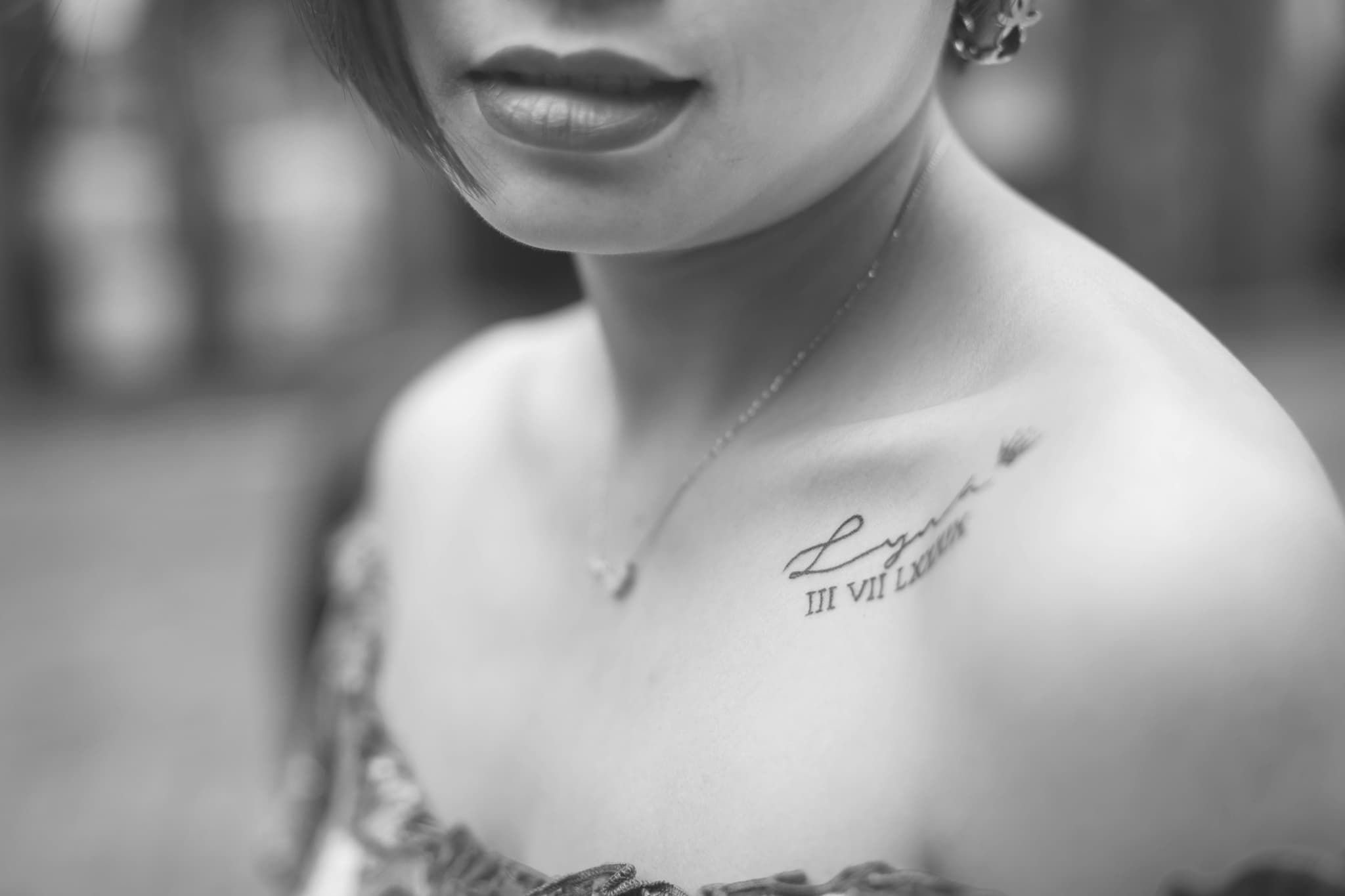
Diagnosis dates, last-chemo dates, remission dates and "cancer-free since" marks look striking in Roman numerals or fine line work. You could also use the GPS coordinates of the hospital where you were treated, or of a place that matters: the home you went back to, the lake where you took your first real walk after treatment. These tattoos are deeply personal without announcing themselves to anyone who doesn't already know the story.
If a "cancer-free since" date is the one you're thinking of inking, our article on what it means to be 5 years cancer-free explains what that milestone does and doesn't tell you.

Cancer Ribbon Tattoos: Beyond the Basic Pink
The awareness ribbon is instantly recognizable, which is exactly why some people dismiss it as generic. I'd push back on that. A ribbon becomes meaningful the moment you customize it with color, context or personal detail, and there's far more room to customize than you might expect.
Cancer Ribbon Colors by Type
If you're planning a meaningful cancer ribbon tattoo, here's a key to common ribbon colors, based on a list published by the US-based National Foundation for Cancer Research [1]. European patient groups may use different shades, so if the exact color matters to you, check with the patient organization for your cancer type.
| Ribbon color | Cancer type |
|---|---|
| Pink | Breast cancer |
| Teal | Ovarian cancer |
| Teal and white | Cervical cancer |
| Gold | Childhood cancer |
| Gray | Brain cancer |
| Pearl or white | Lung cancer |
| Light blue | Prostate cancer |
| Dark blue | Colorectal cancer |
| Purple | Pancreatic cancer |
| Light purple | Testicular cancer |
| Orange | Leukemia and kidney cancer |
| Lime green | Non-Hodgkin lymphoma |
| Violet | Hodgkin lymphoma |
| Yellow | Sarcoma and bone cancer |
| Black | Skin cancer and melanoma |
| Burgundy | Multiple myeloma |
| Lavender | All cancers |
Some colors are shared (orange covers both leukemia and kidney cancer), and some ribbons combine colors, like pink and blue for male breast cancer [1]. If you've had more than one cancer, or you want to honor your own diagnosis and a loved one's, you can combine colors too.
Creative Ways to Customize a Ribbon
If a plain ribbon feels too expected, try a watercolor ribbon with soft color bleeds, which feels modern and less clinical. You could weave a semicolon into it, shape it into an infinity loop, or let one end dissolve into flowers, birds or feathers.
You can also form a ribbon from a loved one's handwritten word, or pair it with a date, coordinates or a heartbeat line running through it. A ribbon can become a bracelet, an ankle band or part of a larger sleeve. It's only as generic as you let it be.
When You're Honoring Someone Else
Some of you are reading this because you want a ribbon for a parent, partner or child rather than for yourselves. That's a whole category of its own, and I cover memorial tattoos in depth below.
Tattoos That Cover Scars, Ports, and Radiation Marks
Treatment leaves marks, and a tattoo is one way to reclaim that skin.
Scars vary from person to person and depend on the surgery you had [2], so this is work for an artist who has tattooed around scars before. Ask to see examples of their mastectomy or scar work before you commit [2].
Mastectomy Scar Cover-Ups
Florals across the chest, mandalas, vines and full "garden" pieces are all ways to work with mastectomy scars. Most tattoo artists build the scar into the design rather than tattooing straight over it, though it's sometimes possible to put ink directly into the scar [2]. Some studios also offer a patch test before you start, which checks for a reaction to the pigment [2].
Your scars need to be completely healed first. That takes around a year, and Breast Cancer Now suggests waiting longer if you can [2].
3D Nipple and Areola Tattooing After Mastectomy
This is a specialty of its own, and it's worth knowing about if you've had a mastectomy. Nipple and areola tattoos aim to create a natural-looking nipple on the skin [2], and practitioners use different techniques to build up color and create a 3D effect [3]. They're usually done by a doctor or nurse with specialist training, although some tattoo artists specialize in this work too [2].
In the UK, NHS hospitals such as Guy's and St Thomas' and The Christie offer it after breast reconstruction. At Guy's and St Thomas', your consultant refers you to the breast reconstruction nurse specialist team [3], and The Christie uses tattoos to recreate the areola and nipple for people who have had a reconstruction [6]. Elsewhere in Europe, what's included depends on your national health system or insurer, so ask your breast care team before you pay privately.
Quick win: Before you book a private session for nipple and areola tattooing, ask your breast care team whether it's already part of the reconstruction care you're entitled to.
Port Scars and PICC Line Marks
A port scar can be the first thing you notice in the mirror each morning, and it can carry more weight than its size suggests. Ports usually sit under the skin of the upper chest, sometimes in the arm, and the cut for the port itself is about 3 to 4 cm long [7].
Small florals, a bird in flight, a single meaningful word, a geometric design or a small ribbon can all work here. Talk placement through with your artist, especially if the scar sits close to bone.
Radiation Tattoo Dots: Cover, Remove or Keep
Those tiny dots your radiotherapy team made are permanent pinpoint tattoos. Radiographers may make between one and five of them and use them to line up the machine, so the same area is treated each time [8].
You have three options. You can cover them with a small design; you could even turn them into a tiny constellation, literally connecting the dots. You can have them removed: in a randomized trial by researchers in Denmark, carried out in women with radiotherapy tattoo marks, both laser treatment and punch excision cleared the marks well, and most patients preferred the laser [9]. Or you can leave them as part of your story. If you decide to tattoo over them, wait until you've finished and recovered from radiotherapy first [2], which brings us to timing.
Memorial Tattoos: Honoring Someone You've Lost to Cancer
Some of you are here because you lost someone: a parent, a child, a spouse, a sibling, a best friend. Memorial tattoos are every bit as meaningful as survival tattoos, and in some ways more. You're carrying someone who can't carry themselves anymore.
A gentle caution: grief tattoos can feel urgent in the weeks right after a loss. The impulse to mark it immediately, to do something, is real and understandable. But it can help to give yourself some months before you decide, so the design reflects lasting memory rather than the rawest days of grief. Take your time. You won't forget them.
Design Ideas for Memorial Tattoos
Some of the most meaningful memorial designs are also the simplest:
- Their actual handwriting: a signature from a birthday card, "I love you" from a note, a phrase they said often
- Their voice waveform, made from a saved voicemail and turned into a sound-wave line tattoo
- Their favorite flower
- A portrait in fine-line realism (choose an artist with portrait experience for this)
- Birth and death dates in Roman numerals
- A song lyric that was theirs
- The ribbon color of the cancer that took them, perhaps combined with their initials
- An empty chair, empty swing or empty bench silhouette
- Matching tattoos shared across family members who all loved the same person
What Feels Different About Memorial Tattoos
You might want a memorial tattoo somewhere private: the rib cage, the inner arm, over the heart or the back of the neck. These tattoos are for you first and the world second.
Some people ask about having a small amount of cremated ashes mixed into the ink. If that idea speaks to you, talk it through with both your artist and your doctor before you decide.
Grief is non-linear. Some people want their memorial tattoo within weeks, while others need years. Both are right.
When Is It Safe to Get a Tattoo After Cancer Treatment?
This matters more than any design decision you'll make. Treatment affects your blood counts, how quickly your skin heals and how mature your scars are, and each of those matters when a needle breaks the skin [4][2].
Every answer here ends with "talk to your treatment team," because individual circumstances vary a lot. What follows is what UK patient guidance says, as a starting point for that conversation.
How Long to Wait After Chemotherapy
There's no single number of months that fits everyone. Blood Cancer UK's advice is to wait until your blood counts are back in the normal range [4]. Tattooing breaks the skin with fine needles, so you need enough white blood cells to fight off infection and enough platelets to stop bleeding [4]. Breast Cancer Now adds that you should have finished and recovered from chemotherapy first [2].
Your tattoo may also heal more slowly than usual [4]. If you've had a stem cell or bone marrow transplant, full recovery can take up to a year [10], so ask your transplant team when your body is ready.
Tattooing on Radiated Skin
Radiotherapy can leave lasting changes in the treated area. Sometimes the skin stays slightly darker or lighter than it was before [11].
Breast Cancer Now advises finishing and recovering from radiotherapy before you get a tattoo [2]. Ask your radiotherapy team to look at the skin before you book, and choose an artist who wants to see it in person too.
Lymphedema Risk: What to Know Before You Choose a Spot
After breast cancer treatment, you may be at risk of lymphedema if you've had surgery or radiotherapy to your lymph nodes, and the risk is greater if you've had both [12]. It can show up in the months after treatment or many years later [12].
Here's what the evidence says about tattoos specifically. After breast cancer surgery, there's limited evidence that a tattoo on the breast, chest or arm on the side of your surgery raises your risk of lymphedema in that area [2]. What can raise the risk is an infection: you may be more at risk of lymphedema if you get an infection after your tattoo [2].
If you already have lymphedema, speak to your treatment team before you have a tattoo [2]. If your lymph node surgery was somewhere else, such as the groin, ask your own team the same question before you choose a spot on that side.
Questions to Ask Your Oncology Team Before Booking
Bring this list to your next appointment, or call your oncology nurse line:
- Are my blood counts (white blood cells and platelets) in a safe range for a tattoo right now?
- How long after my last treatment do you recommend waiting?
- Are there any areas of my body I should avoid tattooing? (Lymphedema risk, radiotherapy sites, near a port, near a reconstruction.)
- Am I on any medications that affect bleeding or healing?
- Do I need antibiotics before or after the tattoo?
- What specific signs of infection should I watch for, given my history?
- Is there any reason I shouldn't get a tattoo at all right now?
Do / Don't: A Quick Reference for Survivors Getting Tattooed
Before you book, here's the condensed version of everything above. If nothing else sticks, this table should.
| ✓ Do | ✗ Don't |
|---|---|
| Check with your treatment team before you book [2] | Book before you've talked it through with your team |
| Wait until you've finished and recovered from chemotherapy or radiotherapy [2] | Get tattooed while your blood counts are below the normal range [4] |
| Choose an artist who has tattooed around scars before [2] | Assume every artist is comfortable working on scars |
| Talk to your team first if you have lymphedema [2] | Ignore redness or swelling that gets worse, especially with a fever [2] |
| Wait until scars are completely healed, which takes around a year [2] | Tattoo over a fresh scar or a healing port site |
| Use sunscreen with SPF 50 or above for at least a year after radiotherapy ends [11] | Swim, sunbathe or use a sunbed in the first two weeks [2] |
| Sit for a consultation before the appointment | Book same-day on a whim, especially for memorial tattoos |
| Ask whether nipple and areola tattooing is part of your reconstruction care | Pay privately before you've checked what your health service offers |
How to Choose the Right Tattoo Artist
Getting the design right matters less than getting the artist right. For cancer survivors, "find someone clean and licensed" doesn't go far enough. You may need someone with experience of scar tissue, medical tattooing or mastectomy work.
What to Look for in a Portfolio
Look for healed work, not just fresh tattoos. Fresh tattoos always look good. Healed work, six months or a year on, shows you how the lines hold, how the color ages and how the tattoo actually lives on skin over time.
Check for consistent line weight and color saturation. If it's relevant to your design, look for scar cover examples and a range of skin tones in their portfolio. If you can't find healed work on their page, just ask. A confident artist will send you photos.
Red Flags: Hygiene, Licensing, and Attitude
Tattoo artists should always use sterile equipment and fresh needles [2]. In the UK, anyone who tattoos should be registered with their local authority, and you can contact the authority to check [2]. If you live elsewhere in Europe, ask which registration or license your country requires and whether the studio holds it. You can also ask to see their setup. A professional won't be offended.
The attitude red flags matter just as much. An artist who dismisses your medical history, rolls their eyes at your oncologist's advice or pressures you into a bigger or different design than you wanted is not the right artist. Walk out. This is a permanent decision about your body, and you get the final say.
Finding a Paramedical or Scar-Work Specialist
Medical tattooing is its own skill. Nipple and areola tattoos are usually done by a doctor or nurse with specialist training, and some tattoo artists specialize in this work too [2]. Hospital teams also use medical tattooing to camouflage some scars [6].
Good starting points:
- The Mastectomy Tattooing Alliance lists recommended UK-based artists who have done mastectomy tattoos before [2].
- Your breast care team can tell you whether nipple and areola tattooing is offered where you were treated, and they may know local artists who do scar work.
- A patient organization for your cancer type in your country may know of specialist artists or support schemes near you.
Placement Considerations Specific to Survivors
Generic "wrist or shoulder" advice doesn't really cut it for cancer survivors. Placement intersects with lymphedema risk, radiotherapy sites, scar healing and the visibility choices that mean something to you emotionally.
Visible or Private: What Do You Want the Tattoo to Do?
A visible placement on your forearm, wrist or the back of your hand makes the tattoo a daily reminder for you, and an open door for conversations with other survivors. You'll get asked about it. Some people love that. Others want nothing to do with it.
Private placements (ribs, inner bicep, over the heart, the back of the neck, the shoulder blade) keep the tattoo yours. It isn't hidden out of shame; it's held close. Neither choice is braver than the other. It's about what you need the tattoo to do for you on an ordinary Tuesday morning five years from now.
Medically Informed Placement
If you have lymphedema, talk to your team before you choose the arm, breast or chest on that side [2]. Wait until you've recovered from radiotherapy before you tattoo the treated area [2]. If you're thinking about tattooing over a reconstruction, check with your surgical team first. And if an area has lost feeling since surgery, tell your artist before they start.
Good spots for cover-up work include healed mastectomy scars, the upper chest for a port scar, and the décolletage for a radiotherapy-dot constellation. Ask your artist to place the stencil, take a photo and show it to your treatment team before you sit for the real session. Five minutes of checking is worth it.
Aftercare: What's Different When You're a Cancer Survivor
Standard tattoo aftercare is on every shop's handout. This is the aftercare-plus list that matters when your body has been through what yours has.
Standard Aftercare, Briefly
Your artist should give you instructions for looking after your tattoo, so follow theirs first [2]. Keep the area clean and dry, wash your hands before you touch it, and ask your artist which cream, if any, to use [2]. For the first two weeks, skip swimming, sunbathing, sunbeds and exercise that makes you sweat [2]. Hospital aftercare advice for nipple and areola tattoos adds two rules worth borrowing: don't soak the area in the bath, and don't pick or peel the scabs, because that can pull out the color and cause scarring [3].
Survivor-Specific Aftercare
Know the signs of infection. Redness or swelling that doesn't settle or keeps getting worse, together with a high temperature or feeling feverish, may mean an infection [2]. If that happens, contact your GP, an urgent care service or the emergency department as soon as possible [2], and let your oncology team know too.
Your tattoo may heal more slowly than usual after treatment [4]. Sun protection matters as well. After radiotherapy, the NHS advises a high-factor sunscreen (SPF 50 or above) for at least a year after treatment ends [11], and high-factor sunscreen on the tattoo itself helps reduce fading [2]. If you're on immunosuppressants, biologics or hormone therapy, ask your oncology team whether any of those change your aftercare plan.
Cost, Health Service Cover, and Help With Mastectomy Tattoos
Money is a real question, especially if treatment has already stretched your budget. The good news is that nipple and areola tattooing may be part of your hospital care, and some schemes help with the cost of decorative mastectomy tattoos.
Tattoo Costs
Prices vary widely by country, city, size, detail and artist, so ask for a written quote at your consultation. Larger pieces and work around scars can take longer, sometimes over more than one session, and that affects the price.
Is Nipple and Areola Tattooing Covered?
In the UK, NHS hospitals such as Guy's and St Thomas' and The Christie provide nipple and areola tattooing after breast reconstruction [3][6]. In other countries, it depends on your national health system or insurer, so ask your breast care team what's included before you pay for it privately.
Help With the Cost
In the UK, the Mastectomy Tattooing Alliance funds its approved artists to make tattoos more accessible and affordable for people affected by breast cancer [2]. Outside the UK, ask your breast care nurse or a patient organization whether a similar scheme exists where you live. It's also worth asking your local studio directly.
Frequently Asked Questions
How long after chemotherapy can I get a tattoo?
Can I get a tattoo during cancer treatment?
Is it safe to tattoo over a mastectomy scar?
Does insurance cover nipple tattoos after mastectomy?
It depends on where you live. In the UK, NHS hospitals such as Guy's and St Thomas' provide nipple and areola tattooing after breast reconstruction [3]. Elsewhere, ask your breast care team what your health system or insurer includes before you pay privately.
What's a paramedical tattoo?
Can I tattoo over my radiation marks?
What ribbon color represents my type of cancer?
Pink is breast cancer, teal is ovarian, gold is childhood cancer and gray is brain cancer, for example [1]. Some colors are shared, so check the full chart earlier in this guide.
I want a memorial tattoo for someone I lost. How soon is too soon?
There's no right timeline. Giving yourself a few months can help, so the design reflects lasting memory rather than raw grief. Take the time to settle on something that will still feel right in ten years.
Will a tattoo trigger lymphedema?
Final Thoughts: It's Your Body and Your Story
There's no right way to get a meaningful cancer survivor tattoo. Some of you are marking survival. Some of you are reclaiming a body that treatment changed. Some of you are carrying someone you loved through every day that's left. All of it counts.
The tattoo isn't really about the image you choose. It's about deciding what your body says about what you've been through, and who gets to decide that. The answer, finally, is you.
Two things are non-negotiable. Get your treatment team's go-ahead on timing and placement. Find an artist who understands your skin's history and respects it. Beyond that, take your time. The tattoo will still be there next month, next year, or whenever you're ready. The right design, the right artist and the right moment are worth waiting for.
When you sit down in that chair, you'll know.
References
[1] Webber, D. (2025, August 8). Cancer ribbon colors and what they represent. National Foundation for Cancer Research. https://www.nfcr.org/blog/cancer-ribbon-colors-and-what-they-represent/
[2] Breast Cancer Now. (2024). Decorative tattoos after breast cancer surgery. https://breastcancernow.org/information-support/facing-breast-cancer/living-beyond-breast-cancer/your-body/artistic-tattoos-after-breast-cancer-surgery
[3] Guy's and St Thomas' NHS Foundation Trust. (2025). Nipple areola tattooing. https://guysandstthomas.nhs.uk/health-information/nipple-areola-tattooing
[4] Blood Cancer UK. (n.d.). Your infection questions answered. Retrieved November 17, 2026, from https://bloodcancer.org.uk/understanding-blood-cancer/treatment/infection-neutropenia-sepsis/infection-questions-answered/
[5] Project Semicolon. (n.d.). The semicolon tattoo. Retrieved November 17, 2026, from https://projectsemicolon.com/the-semicolon-tattoo/
[6] The Christie NHS Foundation Trust. (2024). Medical tattooing. https://christie.nhs.uk/patients-and-visitors/your-treatment-and-care/treatments/surgery/plastic-surgery/medical-tattooing
[7] Macmillan Cancer Support. (2022). Implantable ports. https://www.macmillan.org.uk/cancer-information-and-support/treatment/types-of-treatment/chemotherapy/implantable-ports
[8] Cancer Research UK. (2023). Radiotherapy tattoos. https://www.cancerresearchuk.org/about-cancer/treatment/radiotherapy/external/planning/skin-markings
[9] Bregnhøj, A., & Haedersdal, M. (2010). Q-switched YAG laser vs. punch biopsy excision for iatrogenic radiation tattoo markers: A randomized controlled trial. Journal of the European Academy of Dermatology and Venereology, 24(10), 1183-1186. https://research.regionh.dk/da/publications/q-switched-yag-laser-vs-punch-biopsy-excision-for-iatrogenic-radi/
[10] NHS. (2026). Recovering from a stem cell or bone marrow transplant. https://www.nhs.uk/tests-and-treatments/stem-cell-or-bone-marrow-transplants/recovery/
[11] NHS. (2023). Side effects of radiotherapy. https://www.nhs.uk/tests-and-treatments/radiotherapy/side-effects
[12] Breast Cancer Now. (2024). Lymphoedema. https://breastcancernow.org/information-support/facing-breast-cancer/going-through-treatment-breast-cancer/side-effects/lymphoedema
This article provides informational support only and is not a substitute for professional medical advice, diagnosis, or treatment. Always consult your healthcare provider for medical decisions.

This content was created during the YARN project, co-funded under the EU4Health Programme in 2025-2028 (Grant Agreement No. 101219053).