


Key takeaways
- A short positive message for a cancer patient is usually easier to take in than a long speech. Fatigue is very common in people with cancer [1]. A two-line text they can re-read on a bad day asks much less of them than a paragraph they feel they must answer.
- The best message meets the person where they are: just diagnosed, mid-chemo, after surgery, in remission or living with advanced disease. Each moment asks for different words.
- Skip battle metaphors like "fight," "warrior" and "beat this" unless the patient uses them first. A study of posts on a UK online forum for patients found that fighting and battle language can express and reinforce negative feelings, but can also be used in empowering ways [2].
- Leave out "stay positive" and "everything happens for a reason." Both can sound like a request for the person who is ill to manage your feelings as well as their own.
- Offer something concrete instead of "let me know if you need anything." "I'm dropping off soup on Thursday, so leave a cool bag on the doorstep" is easy to say yes to.
- End your message with "no reply needed" so they don't feel they owe you an answer on top of everything else.
Your friend just told you they have cancer. Or your coworker. Or your mum. And now you're staring at a blank text box, rewriting the same three sentences, deleting them, and rewriting them again.
You're in the right place. This is a guide to writing a short positive message for a cancer patient: one that sounds like you and doesn't add to the load of the person reading it.
What follows isn't a dump of 100 inspirational quotes. The messages are organised by situation, because the words that work in the week of a diagnosis aren't the words that work in month six of chemo, or when treatment ends. There are 80+ you can copy, adapt or use as a starting point, along with plain advice on what to avoid and why.
The short version: the message you're overthinking is probably already enough. Send it.

Why a Short Message Matters More Than a Long Speech
People in treatment are often running on very little. Fatigue is very common in people with cancer, doesn't usually go away with sleep or rest, and can mean that even a chat feels like too much [1].
Studies, mostly in people treated for breast cancer, find that memory and attention are among the abilities most affected after chemotherapy [3]. People often call it "chemo brain." A long, carefully worded tribute can feel like homework to read.
A short message, on the other hand, can be glanced at between naps. It can be re-read on the bad days. It doesn't demand a thoughtful reply when replying is the last thing someone has in them.
There's another reason to keep it short. Long messages can slide, without meaning to, into being about the sender: a tribute to the person's strength, a rundown of your own feelings, an attempt to tie everything up neatly. A short note keeps the attention on them.
What Makes a Message Actually Helpful vs. Hollow
Four qualities separate messages that help from messages that just fill space:
- Specific: mentions the person, a shared detail or the actual day
- Honest: doesn't pretend things aren't hard
- Low-pressure: doesn't demand a reply, positivity or a performance
- Sincere: sounds like you, not like a card rack
Here's the difference in action:
Hollow: "Sending prayers and positive vibes! Stay strong, warrior! You've got this!" Genuine: "Thinking of you today. No need to write back. Just wanted you on my phone screen."
The first is loud and busy. The second is small and real. That's the one to send.
12 Short Positive Messages That Work in Almost Any Situation
These are your evergreen starting points. Any of them can be sent as they are, or adapted with a single personal detail only you would know. Aim for one line. Two at most.
- "Thinking of you today. No reply needed." Easy to adapt, and it asks for nothing.
- "You don't have to be brave with me." Gives them permission to be tired, angry or scared.
- "I love you. That's the whole text." For when you can't find the words.
- "I'm here. Not going anywhere." Reassurance without pressure.
- "Just wanted you to know you're on my mind." Light and warm, with no demands.
- "However today is, that's okay." Meets them wherever they are.
- "I'm bringing dinner on Tuesday. Tell me what sounds edible this week." A concrete offer with a built-in opt-out.
- "No update needed, I just wanted to wave at you." Useful when you'd rather not ask "how are you?"
- "You're loved. Full stop." Short, grounded, true.
- "Holding you in my thoughts today." An old standby that still does the job.
- "Sending you quiet and a hot drink, wherever you are." Small and specific.
- "I'm thinking about you and I don't need you to be okay right now." Takes the pressure to seem fine off the table.
A note on these: they're starting points, not finished products. The best version of any of them adds one detail only you would know: a nickname, a reference to last Tuesday, the name of their dog. We'll come back to that trick in a minute.
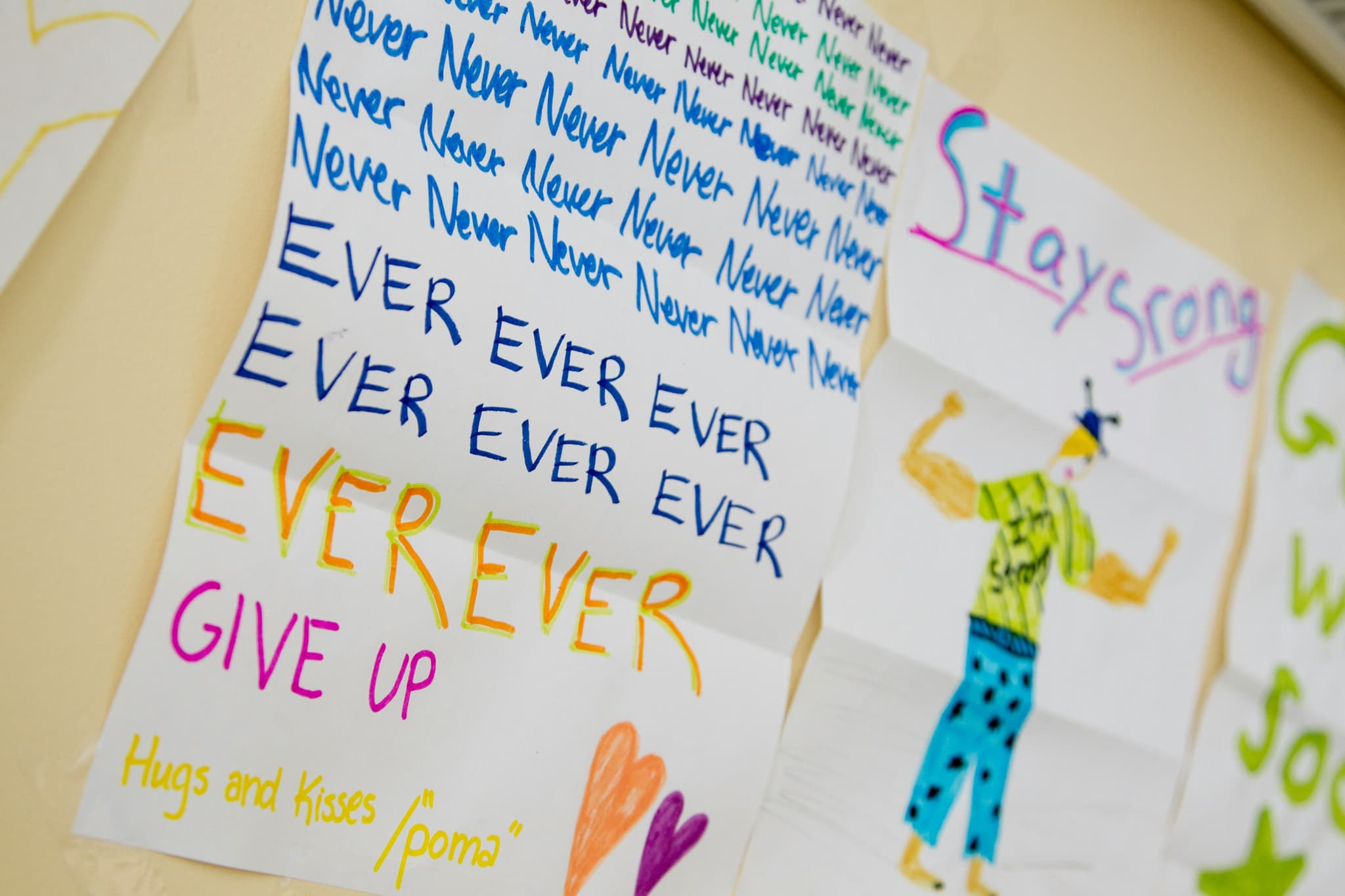
Messages for Someone Who Was Just Diagnosed
The first few days after a diagnosis can feel unreal. The person may not know their treatment plan yet and may be buried in appointments, leaflets and late-night searches. They don't need your advice right now. They need to know they aren't on their own.
This is not the moment for survival statistics, supplement tips or the story of your aunt who had the same thing. Even if your aunt is thriving. Keep it to yourself for now.
10 Things to Say in the First Days After a Diagnosis
- "I heard. I'm so sorry. I'm here: today, next week, in six months."
- "You don't have to have any answers yet. I'm just glad you told me."
- "I love you. I'm not going anywhere."
- "Take whatever time you need to tell people. No pressure on your end."
- "This is a lot. I'm not going to try to fix it. I just want you to know I'm here."
- "Whatever you need, and also whatever you don't need, I'm around."
- "I'm so sorry you're carrying this. You're not carrying it alone."
- "No advice from me. Just love."
- "Whenever you want to talk about it, or not talk about it, I'm here for both."
- "I'm thinking of you. Don't write back. I just wanted you to know."
A Note on Offering Help That's Actually Useful
"Let me know if you need anything" sounds generous. In practice it hands the work back to the person who's ill: they have to work out what they need, get past the awkwardness of asking, and manage your feelings about helping.
Make a concrete offer instead. Pick something specific, name the day and give them an easy way out.
- "I'm bringing dinner on Thursday at 6. Leave a cool bag on the doorstep if you're not up for company."
- "I'll drive you to your Tuesday appointment. I can read a book in the waiting room or drop you off, your call."
- "I'm mowing your lawn on Saturday. You don't have to be home or say thank you."
Each one names a specific action and a specific time. None needs a reply, and none expects thanks.
Encouraging Words During Chemo or Radiation
Treatment can run for months, and it's easy for messages to dry up long before it ends. That's when a check-in counts most.
Encouraging words during chemo don't need to be inspirational. They need to be small and regular, and they shouldn't ask for anything back. Think of yourself as a low, steady drip of care across many months, not one big speech. If you'd like more wording for this stage, our guide on what to say to someone going through chemo treatments has supportive phrases and practical tips.
10 Messages for the Middle of Treatment
- "No update needed. Just wanted you on my screen today."
- "Thinking of you while your infusion's running. Don't reply."
- "I know this week is a hard one. Sending you quiet."
- "Queued up some bad reality TV recommendations for you. Ready when you are."
- "You're allowed to hate this. I'd hate it too."
- "Still here. Still thinking of you. Still not expecting a response."
- "Midweek wave. That's the whole text."
- "I saw [something small that reminded me of you] and it made me smile."
- "Three words: you're loved today."
- "Whatever version of you shows up this week, I'm here for it."
Messages for a Specific Hard Day
Scan day. The first day of a chemo week. The morning of an operation. A message tied to a date like that shows you've been paying attention, which a general "thinking of you" can't quite do.
- "Scan day. You've got this part. I'm sitting with you in spirit."
- "Today's a chemo Monday. Thinking of you through it."
- "Tomorrow's the big scan. Whatever the results, I'm here for both versions."
- "Big day today. No reply. Just love."
Put their treatment dates in your calendar and send the text that morning.

Messages After Surgery or a Major Procedure
Right after an operation, a long message can be too much to read. Keep yours brief, tell them they're loved and that you expect nothing back, and drop off something soft to eat if you can.
8 Short Post-Surgery Messages
- "You're on the other side of it. That's the hard part done. Rest."
- "Don't read this now. Reading it later still counts."
- "So glad you're out. Nothing else required of you today."
- "I'll be by with groceries on Saturday. Leave a note on the door if you're sleeping."
- "Healing isn't linear. Whatever today looks like is fine."
- "You made it through. Proud of you. Now nap."
- "No reply. Just wanted you to know I'm glad you're okay."
- "I dropped soup on your doorstep. Don't get up."
Several of these tell the person not to reply, and that's deliberate. After an operation, even looking at a phone screen can be more than someone wants to do.
Messages for Someone in Remission or Finishing Treatment
Finishing treatment can bring a low of its own. In an interview study of 22 cancer survivors with a favourable prognosis, the survivors described an emotional fallout that often followed treatment, with a loss of direction and control once medical care stopped, less support from health professionals and from their social network, and an emotional setback [4].
Then there is the worry. Fear of the cancer coming back is common too: a systematic review and meta-analysis using data from 13 countries found it across cancer types and for all time periods since diagnosis [5].
Your messages should make room for all of that. "Congrats, you beat it!" can feel isolating to someone who's quietly dreading their next scan.
8 Messages for the End of Active Treatment
- "Whatever you're feeling about being done, all of it makes sense."
- "Proud of you, and also here for whatever this next part feels like."
- "Ringing the bell is huge. So is needing a nap for six months afterwards."
- "You don't have to feel a certain way about this. I'm just glad you're here."
- "The 'after' can be its own odd chapter. I'm still around."
- "Treatment ending doesn't mean you have to be over it. Take your time."
- "I see you. This part counts too."
- "Celebrating with you, and also ready to sit with the hard stuff whenever."
Messages for Someone Living With Advanced or Terminal Cancer
Messages for this stage deserve their own section. Love doesn't stop being needed when treatment stops working, and the words need more care, not less.
Drop the "keep fighting" language here. Macmillan Cancer Support's UK report on advance care planning describes how the longer "fighting" conversations go on, the harder it becomes for patients and professionals to shift towards planning ahead, and says patients find the effort of keeping up a brave face exhausting [6]. "Don't give up" can also sound as if the illness getting worse is somehow the person's fault. It isn't. What helps instead is presence, specificity and love that doesn't depend on how things turn out.
What to Say, and What to Leave Out
Leave out: "You'll beat this," "Don't give up," "Stay positive," "Think of all there is to live for," and any version of "There must be something else you can try."
Lean into: presence, shared memories, specific love, honest gratitude, and an acknowledgement that this is hard and unfair and that they deserved better.
8 Messages for This Moment
- "I love you. I'm not going anywhere, now or later."
- "You've shaped my life in ways you probably don't realise. Let me tell you some of them."
- "No agenda today. Just thinking of you."
- "Whatever this day looks like is okay. I'm here for it."
- "I'm so grateful I know you. That's not going to change."
- "You don't owe anyone a brave face today. Especially not me."
- "I love you. Fully. Exactly as you are right now."
- "Remember when [specific memory]? I think about that all the time."
That last one carries the most weight. A specific memory can say "you mattered" more clearly than any general sentiment.
What to Write in a Card, Text, or Short Email
The medium shapes the message. A get-well card isn't a text, and a text isn't a social media comment. Here's how to adjust for each.
In a Get-Well Card
A card can be picked up and read again on a bad day. Include something concrete the person can hold onto.
Template: one short, honest sentence, one specific detail and some love.
"Thinking of you through this, and still laughing about the pumpkin incident last October. I love you." Sam
Three sentences. Done.
In a Text Message
Keep it short, make the reply optional, and think about timing. Send it on the morning of a hard day, not at 11 p.m. when you want to feel better about not having texted.
"Thinking of you today. No need to write back. Love you."
In a Short Email
Email suits a friend who lives far away, a coworker, or a relationship that's more formal. Keep it just as short and low-pressure.
Subject: thinking of you No reply needed. I just wanted you to know you've been on my mind this week. I'm here if and when it's ever useful. Sending love.
In a Social Media DM or Comment
Public comments can feel performative, especially under a post announcing a diagnosis. A private message can feel more personal than a public "sending prayers!" Save public comments for milestones the person shares themselves, and keep those short too.
Messages of Strength and Hope (Without Toxic Positivity)
"Toxic positivity" is the pressure to feel good about something that isn't good. Telling someone with cancer to "stay positive!" can sound like a request to keep their fear, anger and sadness to themselves. In a 2017 YouGov survey for Macmillan Cancer Support, more than one in four people in the UK with a cancer diagnosis said they feel guilty if they can't stay positive about their disease [6].
Real hope doesn't need forced brightness. It can sit next to hard feelings instead of replacing them.
The Difference Between Hope and Pressure
| Sounds like hope | Sounds like pressure |
|---|---|
| "Whatever today is, I'm here." | "Stay positive!" |
| "I'm holding hope for you when it feels too heavy." | "Don't let it get you down!" |
| "You don't have to be okay. I'm still here." | "Good vibes only!" |
| "However you're feeling makes sense." | "Everything happens for a reason." |
The left column leaves room for whatever the person is actually feeling. The right column quietly asks them to perform being well.
8 Honest Messages That Still Hold Hope
- "This is hard, and you don't have to pretend otherwise. I'm still here."
- "I'm holding hope for you on the days it feels too heavy to carry yourself."
- "Even on the worst days, I'm not going anywhere."
- "You don't have to feel brave. You're loved either way."
- "Hoping for good news with you, and here for whatever news comes."
- "Today might be awful. Tomorrow might be too. I'm in it with you."
- "I believe in better days, and I believe in this one too, ugly as it is."
- "Whatever you need to feel today, feel it. I've got the hope part for now."
What NOT to Say (and Why It Hurts)
Some phrases sound kind and land badly. Here are six worth leaving out, with the reason for each, and a table of what to say instead.
Six Phrases That Land Badly (and Why)
- "Everything happens for a reason." Nobody deserves cancer, and this phrase can make it sound as if there's a lesson plan behind it.
- "Stay positive!" or "Good vibes only!" It adds pressure to look well when they may not feel well, and it can make honest feelings seem unwelcome.
- "At least they caught it early." It minimises. Early or not, it's still cancer, and you don't know what they're facing.
- "My aunt had this and she [story]." Their cancer isn't your aunt's cancer. A happy ending can sound like pressure, and a sad one can frighten. Neither helps.
- "Let me know if you need anything." It leaves the asking to them. Replace it with a specific offer.
- "You're so strong. I could never do this." It implies they had a choice, and they didn't. "Strong" can also feel like a role they're expected to keep playing.
Say This Instead: A Do/Don't Comparison
| ✗ Instead of… | ✓ Try… |
|---|---|
| "Stay positive!" | "However today feels, that's fine." |
| "Let me know if you need anything." | "I'm dropping off dinner on Thursday at 6." |
| "Everything happens for a reason." | "This isn't fair. I'm so sorry." |
| "You're so brave." | "You don't have to be brave with me." |
| "At least they caught it early." | "I'm so sorry you're going through this." |
| "My aunt had this and she was fine." | "I'm thinking about you. No advice, just love." |
| "You've got this!" | "I'm with you through this, whatever it looks like." |
| "Everything's going to be okay." | "I don't know what's coming, but I'm here for all of it." |
| "How are you feeling?" (for the 50th time) | "No update needed. Just thinking of you." |
| "Keep fighting!" | "I love you. That's the whole text." |
Print this, screenshot it or save it somewhere. The next time you catch yourself typing something from the left column, swap in something from the right.
A Note on "Fighter," "Warrior," and "Survivor" Language
People with cancer don't agree about this language. A study of patients' posts on a UK online forum found that fighting and battle language can express and reinforce negative feelings, but can also be used in empowering ways [2]. Macmillan Cancer Support's UK report on advance care planning adds that patients can find the effort of keeping up a brave face exhausting [6].
The rule is simple: mirror the language the patient uses themselves.
If they describe "my fight" or call themselves a warrior on social media, you can use that language too. If they've said "I'm just living with it" or "I don't really see it as a battle," don't steer them back to "keep fighting!" If you don't know which camp they're in, stay neutral. "I'm here for this" and "I love you through this" fit either way.
How to Personalise Any Message in One Line
One trick turns any message on this page into something the person may want to keep: take a generic message and add one detail only you would know.
The detail can be a nickname, an inside joke, a reference to last Tuesday, their dog's name, a song or a food they love. It shows the message was written for them and not sent to everyone on your list.
For a coworker:
- Generic: "Thinking of you. No reply needed."
- Personalised: "Thinking of you. No reply needed. The office coffee is still terrible without you to complain about it with."
For a close friend:
- Generic: "I love you. I'm here."
- Personalised: "I love you. I'm here. Also: Benny the dog misses you, and so do I."
For a parent:
- Generic: "Thinking of you today."
- Personalised: "Thinking of you today. I made your lasagne last night and got it almost right. Almost."
One detail. That's the whole trick. You already know it, so stop overthinking and write it down.
Beyond Words: Small Gestures That Say More Than a Message
Sometimes the best "message" isn't words at all. An action can say more than a text, especially when the person is too tired to read.
- A supermarket gift card: so they don't have to be seen in public on a bad-hair day
- A specific, delivered meal: with a note saying "heat at 180°C for 20 minutes, no need to thank anyone"
- A petrol station gift card: fuel and parking for hospital trips can add up
- A curated playlist: something quiet, not motivational
- One small, thoughtful item: cosy socks, lip balm, a book you loved
- A scheduled dog walk or pet visit: someone else taking over the dog can lift a weight off a tired household
- A one-off visit from a cleaner: housework is easy to let slide during treatment and hard to ignore
- Sitting in silence: no agenda, no updates required, just company
For more ideas that go further than a note, see our guide on gifts for healing after surgery, which also covers what to avoid. Pair any of these with a short text ("dropped this off") and you've said all that needs saying.
Frequently Asked Questions
What is the best short message to send a cancer patient?
There's no single best message, but a good one is short, specific and low-pressure. A line like "Thinking of you today. No reply needed." is hard to beat. Add one personal detail only you would know and you're done.
What should you not say to someone with cancer?
Avoid "stay positive," "everything happens for a reason," "at least they caught it early," "let me know if you need anything" and stories about other people's cancer outcomes. Each one either hands the emotional work back to the patient, plays down what they're going through, or invites a comparison that doesn't help.
Is it OK to say "stay strong" to a cancer patient?
For some people, yes. For others it can feel like pressure to show a strength they don't feel. A related finding from Macmillan Cancer Support's UK survey: more than one in four people with a cancer diagnosis said they feel guilty if they can't stay positive about their disease [6]. Safer alternatives that still show you care: "I'm here however today looks," "You don't have to be strong with me," or simply "I love you."
What do you write in a get-well card for a cancer patient?
One short, honest sentence, plus one specific detail, plus love. For example: "Thinking of you through this, and still laughing about last Christmas. I love you." A card can be re-read on a hard day, so the specific detail does a lot of the work.
What do you say when someone's cancer is terminal?
Leave out "fight" and "beat it" language. Focus on presence, specific memories and love that doesn't depend on how things turn out. "I love you, and I'm not going anywhere" can say more than most inspirational quotes. Sharing a specific memory of how they've shaped your life can mean a great deal.
Should I text or call someone going through chemo?
Text, in most cases. Fatigue is very common in people with cancer, and on some days even a chat can feel like too much [1]. A text can be read when there's room for it, re-read on a hard day and answered late or not at all. End with "no reply needed" and mean it.
The Message You're Overthinking Is Probably Enough
You came here afraid of getting it wrong. Almost any sincere, short message is better than saying nothing. Awkward words are easier to forgive than a long silence.
Hold on to three principles: short, specific, low-pressure. Meet the person where they are. Skip the battle metaphors unless they use them first. Make concrete offers instead of open ones. End with "no reply needed" so they don't owe you anything on top of everything else.
Then do it: pick one message from this article, add one detail only you would know, and send it in the next five minutes. That's the whole job.
Chances are the exact wording will matter less than the fact that you showed up.
References
[1] Cancer Research UK. (2026, October 14). What is cancer fatigue? https://www.cancerresearchuk.org/about-cancer/coping/physically/fatigue/what-is-cancer-fatigue
[2] Semino, E., Demjén, Z., Demmen, J., Koller, V., Payne, S., Hardie, A., & Rayson, P. (2017). The online use of Violence and Journey metaphors by patients with cancer, as compared with health professionals: A mixed methods study. BMJ Supportive & Palliative Care, 7(1), 60-66. https://doi.org/10.1136/bmjspcare-2014-000785
[3] Lange, M., Joly, F., Vardy, J., Ahles, T., Dubois, M., Tron, L., Winocur, G., De Ruiter, M. B., & Castel, H. (2019). Cancer-related cognitive impairment: An update on state of the art, detection, and management strategies in cancer survivors. Annals of Oncology, 30(12), 1925-1940. https://doi.org/10.1093/annonc/mdz410
[4] van der Smissen, D., Lugtenberg, M., Enting, M., Beerepoot, L., Mols, F., Brouwers, E., Wasowicz, D., & Joosen, M. (2025). Getting back on track after treatment of cancer: A qualitative interview study of cancer survivors' experiences. PLOS ONE, 20(1), Article e0313984. https://doi.org/10.1371/journal.pone.0313984
[5] Luigjes-Huizer, Y. L., Tauber, N. M., Humphris, G., Kasparian, N. A., Lam, W. W. T., Lebel, S., Simard, S., Smith, A. B., Zachariae, R., Afiyanti, Y., Bell, K. J. L., Custers, J. A. E., de Wit, N. J., Fisher, P. L., Galica, J., Garland, S. N., Helsper, C. W., Jeppesen, M. M., Liu, J., . . . van der Lee, M. L. (2022). What is the prevalence of fear of cancer recurrence in cancer survivors and patients? A systematic review and individual participant data meta-analysis. Psycho-Oncology, 31(6), 879-892. https://doi.org/10.1002/pon.5921
[6] Macmillan Cancer Support. (2018, May). Advance care planning report. https://www.macmillan.org.uk/dfsmedia/1a6f23537f7f4519bb0cf14c45b2a629/9238-10061/missed-opportunities-advance-care-planning-report
This article provides informational support only and is not a substitute for professional medical advice, diagnosis, or treatment. Always consult your healthcare provider for medical decisions.

This content was created during the YARN project, co-funded under the EU4Health Programme in 2025-2028 (Grant Agreement No. 101219053).