
Endurance (aerobic) training is an important part of improving fitness, energy levels, and overall health during and after cancer treatment.
It is recommended to do endurance training at least 3 times per week, for 30–60 minutes per session, at:
- Moderate intensity: 64–75% of your maximum heart rate
- Vigorous intensity: 76–95% of your maximum heart rate
Weekly goals:
- 150 minutes of moderate intensity or
- 75 minutes of vigorous intensity or
- An equivalent combination of both.
In addition to the aerobic exercises shown below, we recommend continuous aerobic activities such as:
- Walking
- Cycling
- Swimming
- Skating
- Dancing
- Light jogging (if appropriate for you)
Always consult your healthcare team before starting or changing your exercise routine, especially during or after cancer treatment.
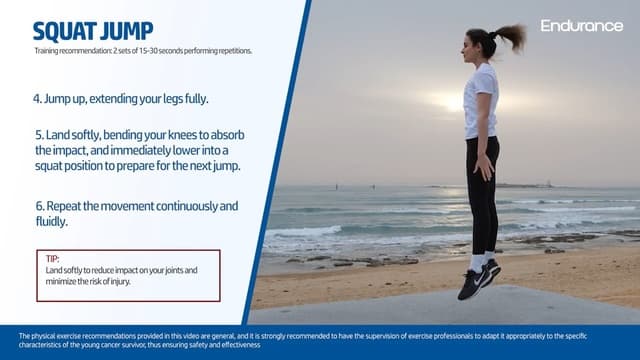
Squat Jump
Exercise explanation:
Squat jumps combine a classic squat with an explosive jump. You start in a squat position with your feet about hip-width apart, lower your hips as if sitting back into a chair, and then push through your feet to jump upwards. Land softly and return to the squat.
This exercise:
- Builds leg strength (thighs and glutes)
- Improves power and cardiovascular fitness
- Can be modified by removing the jump and simply performing bodyweight squats
Pop Squat
Exercise explanation:
A pop squat usually starts with your feet together. You “pop” your feet out into a wide squat position, lower slightly, then “pop” them back together.
This exercise:
- Works the legs and glutes
- Increases heart rate with quick foot movements
- Can be made easier by stepping out instead of jumping

Skater
Exercise explanation:
Skaters mimic the side-to-side movement of a speed skater. You jump or step sideways from one leg to the other, letting the back leg move behind for balance.
This exercise:
- Trains lateral (side-to-side) movement
- Strengthens hips, glutes, and legs
- Improves balance and coordination
- Can be done with small, controlled steps instead of big jumps
Boxing Front Punches
Exercise explanation:
In a slight athletic stance, you repeatedly punch forward with alternating arms, keeping your core engaged and shoulders relaxed.
This exercise:
- Elevates heart rate without heavy impact on the legs
- Engages shoulders, arms, and core
- Can be done standing or seated for lower-impact variation
Jumping Jack
Exercise explanation:
From standing, you jump your feet out to the sides while raising your arms overhead, then return feet together and arms down.
This exercise:
- Is a classic full-body cardio move
- Involves arms, legs, and core
- Can be modified to a “step jack” by stepping one leg out at a time instead of jumping
Jumping Lunge
Exercise explanation:
From a lunge position, you bend both knees, then jump up and switch legs mid-air, landing in a lunge with the opposite leg forward.
This exercise:
- Builds leg strength and explosive power
- Challenges balance and coordination
- Can be modified by performing regular step-back lunges without jumping
Skipping
Exercise explanation:
Skipping can be done with or without a rope. You perform a light, rhythmic hop from one foot to another, often lifting knees slightly.
This exercise:
- Is a rhythmic cardio activity
- Improves coordination and timing
- Can be done at low intensity with small hops
Butt Kicks
Exercise explanation:
While jogging or marching in place, you lift your heels toward your glutes, as if trying to “kick” your own backside.
This exercise:
- Warms up and strengthens the hamstrings
- Raises heart rate gently
- Can be done as a low-impact march if jumping is uncomfortable
Scissor Drill
Exercise explanation:
In the scissor drill, your feet move quickly forward and backward, like alternating lunges or “scissor” steps, usually in a small, fast motion.
This exercise:
- Improves foot speed and coordination
- Works legs and core
- Can be slowed down to a step pattern if needed
Toe Tap
Exercise explanation:
Typically done using a low step or object, you alternately tap one foot and then the other on the surface, maintaining a steady rhythm.
This exercise:
- Is a low-impact cardio drill
- Trains coordination and speed
- Intensity can be adjusted by changing the height of the step and speed
Alternating Toe Touch
Exercise explanation:
From a standing position, you alternately reach one hand toward the opposite foot, either with straight or slightly bent knees, depending on flexibility.
This exercise:
- Engages the core and hamstrings
- Improves flexibility and balance
- Can be done slowly as a controlled mobility exercise
Aerobics Cross Step
Exercise explanation:
You step one foot across the body in front or behind the other foot in a rhythmic pattern, often side-to-side, like a simple dance move.
This exercise:
- Provides low-to-moderate impact cardio
- Trains coordination and rhythm
- Can be easily adjusted in speed and step length
Aerobics V Step
Exercise explanation:
In the V step, you step forward wide with one foot and then the other (forming a “V” shape), then step back to the starting position with feet together.
This exercise:
- Is a classic aerobics step pattern
- Gently raises heart rate
- Can be performed on the floor or on a low step to adjust difficulty
Safety & Progression Tips
- Start with short intervals (e.g., 20–30 seconds per exercise) and longer rests.
- Choose low-impact variations if you feel pain, dizziness, or unusual fatigue.
- Focus on good posture and controlled movement rather than speed.
- Stop immediately and contact your healthcare team if you experience chest pain, severe shortness of breath, or other worrying symptoms.
This article is for educational purposes only and is not medical advice. Always consult your doctor or another qualified healthcare professional for guidance specific to your situation.

This content was created during the OACCUs project, co-funded under the EU4Health Programme in 2021-2024 (Grant Agreement No. 101056984).